

ASU Aerial Self-Supported Fiber Optic Cable (Mini ADSS) ASU Series

Key Features

  • All-dielectric, non-conductive design

  • Lightweight construction for easy aerial handling

  • No grounding or messenger wire required

  • Optimized for 80 m–120 m spans

  • UV, moisture, and temperature resistant

  • Cost-efficient alternative to standard ADSS

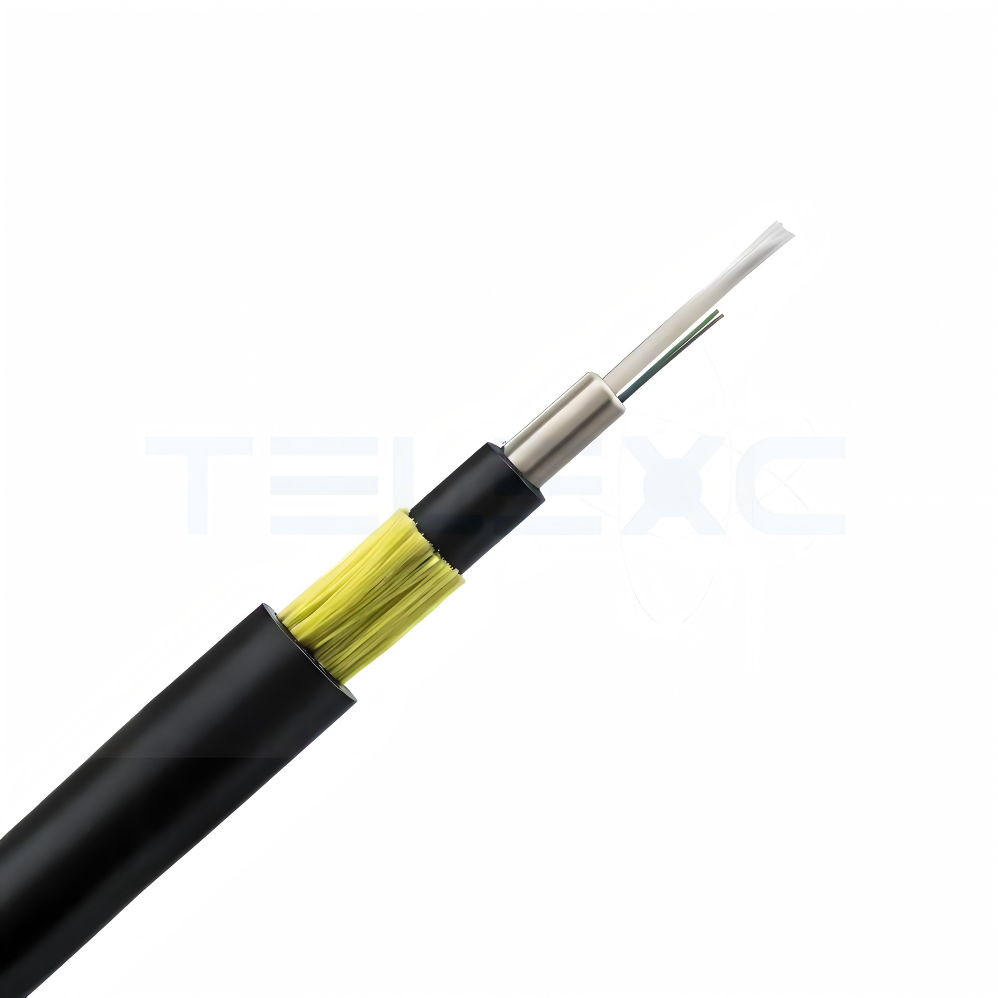
ASU Fiber Optic Cable is a lightweight, all-dielectric aerial cable designed for short- to medium-span distribution networks. The ASU series uses FRP strength members and a loose tube fiber structure to deliver reliable tensile performance without metallic components. Its non-conductive design eliminates grounding requirements and allows safe installation alongside power lines. Optimized for spans of 80 m to 120 m, the ASU series offers an economical alternative to conventional ADSS cables while maintaining strong resistance to UV radiation, moisture, wind load, and temperature variations. The cable is widely deployed in FTTH access networks, rural connectivity, and aerial distribution routes where ease of handling, reduced weight, and long service life are essential.

Model Numbers (ASU Series)

  • TX-ASU-12

  • TX-ASU-24

  • TX-ASU-48

  • TX-ASU-72

  • TX-ASU-96

  • TX-ASU-144

Key Performance Benefits of ASU Fiber Optic Cable

  • Optimized Span Capability
    Designed for typical aerial spans of 80 m to 120 m, offering reliable performance with reduced cable weight.

  • Suitable for Electrically Harsh Environments
    Widely used on overhead communication routes, including installations near high-voltage lines and lightning-prone areas.

  • Lower Deployment Cost
    More than 20% cost savings compared to conventional ADSS cables due to the elimination of aramid yarn and compact structure.

  • High Tensile Strength
    FRP strength members provide stable tensile performance while maintaining an all-dielectric design.

  • Wide Temperature Resistance
    Maintains mechanical and optical stability across both high and low temperature conditions.

  • Long Service Life
    Engineered for over 30 years of reliable outdoor operation under normal installation conditions.

International Standard Compliance

  • IEC 60794-1-2 (Mechanical & environmental tests)

  • ITU-T G.652.D (Optical fiber performance)

  • ISO 9001-compliant manufacturing process

Construction & Materials

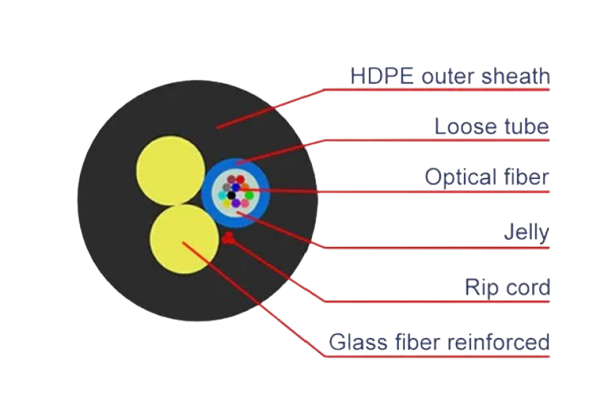
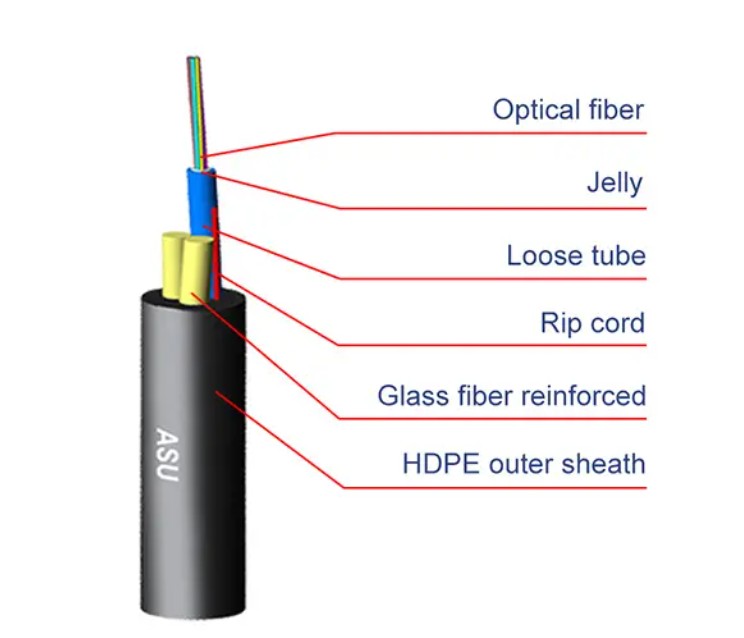
  • Optical Fiber: Single-mode G.652.D

  • Loose Tube: PBT tube filled with water-blocking jelly

  • Strength Members: Parallel FRP elements (non-metallic)

  • Water Blocking: Hydro-expandable yarns/tapes

  • Rip Cord: Integrated for easy sheath removal

    • Cable type and fiber count

    • Manufacturer identification

    • Month and year of production

    • Sequential cable length marking. Outer Sheath: UV-resistant HDPE (black)

      The Fiber Color Code of ASU Fiber Optic Cable

      Packaging & Marking

      Packaging

      ASU fiber-optic cable is supplied on non-returnable wooden drums for safe handling and transportation. Both cable ends are firmly secured to the drum and protected with heat-shrink end caps to prevent moisture ingress during storage and transit.

      Cable Sheath Printing

      The outer sheath is meter-marked at 1-meter intervals (±1%) for accurate length identification. Each marking includes:

      • Cable type and fiber count

      • Manufacturer identification

      • Month and year of production

      • Sequential cable length marking

    Drum Identification

    Each side of the wooden drum is permanently labeled with clear, high-visibility markings, including:

    • Manufacturer name and logo

    • Cable type and total fiber count

    • Cable length

    • Rolling direction indicator

    • Gross weight and net weight

Installation Guide

  1. Inspect the cable drum and route clearance

  2. Install suspension or dead-end clamps sized to cable diameter

  3. Maintain recommended sag and bending radius

  4. Avoid torsion and over-tension during pulling

  5. Secure cable and terminate using standard fiber accessories

Technical Parameters

Parameter 12 Core 24 Core
Fiber Type G.652.D G.652.D
Loose Tube Diameter 2.5 ±0.1 mm 2.8 ±0.1 mm
Strength Member FRP FRP
Outer Sheath HDPE HDPE
Cable Diameter 8.0 ±0.2 mm 8.5 ±0.2 mm
Cable Weight 55 kg/km 65 kg/km
Allowable Tensile Load 1000 N 1500 N
Crush Resistance 1100 N/100 mm 2200 N/100 mm
Installation Temp. −20 °C to +60 °C −20 °C to +60 °C
Operation Temp. −40 °C to +70 °C −40 °C to +70 °C

Applications

FTTH Access Networks

Used extensively in last-mile aerial fiber deployment for residential and commercial broadband connections.

Aerial Distribution Lines

Self-supporting design allows installation between poles without a separate messenger wire.

Power Line Co-Installation

All-dielectric construction enables safe installation on the same poles as low to medium voltage power lines.

Rural & Remote Connectivity

Ideal for villages and remote areas where span lengths are limited, and infrastructure costs must be minimized.

Urban & Semi-Urban Networks

Lightweight cable structure reduces pole loading, making it suitable for congested city environments.

Product Advantages

Lightweight & Easy Handling

Smaller diameter and reduced weight simplify transportation, stringing, and aerial installation.

Cost-Effective Design

Eliminates aramid yarn and grounding hardware, reducing overall project and material cost.

Electrical Safety

Non-metallic FRP strength members prevent electrical conduction and electromagnetic interference.

Environmental Durability

HDPE outer sheath provides strong resistance against UV radiation, moisture, wind, and temperature extremes.

Reliable Mechanical Performance

Designed to withstand tensile load, wind pressure, and ice accumulation in aerial environments.

Long Operational Life

Engineered for stable optical and mechanical performance over more than 30 years of outdoor service.

FAQs

Q1: What is an ASU fiber optic cable?

ASU (Aerial Self-Supported Unit) is a lightweight, all-dielectric aerial fiber cable designed for short to medium spans without a messenger wire.

Q2: How is ASU different from standard ADSS cable?

ASU is optimized for 80–120 m spans with a compact structure, while ADSS is designed for long-span and high-tension transmission routes.

Q3: Does ASU cable require grounding?

No. ASU contains no metallic components and does not conduct electricity.

Q4: What fiber types are supported in ASU?

Single-mode fibers such as ITU-T G.652.D are standard. Other fiber types can be provided on request.

Q5: What is the maximum recommended span length?

Typical spans are 80 m, 100 m, and 120 m, depending on installation conditions and wind load.

Q6: Can ASU be installed near power lines?

Yes. Its dielectric design allows safe co-installation on utility poles with power distribution lines.

Q7: What type of clamps should be used?

Mini-ADSS suspension clamps for straight runs and preformed dead-end clamps for terminations are recommended.

Q8: What is the minimum bending radius during installation?

The minimum bending radius is 20× the cable diameter under tension and 10× when static.

Q9: Is the cable resistant to UV and weather exposure?

Yes. The HDPE outer sheath is UV-stabilized and designed for long-term outdoor exposure.

Q10: How is moisture protection ensured?

The loose tube is filled with water-blocking gel, supported by additional dry water-blocking elements.

Q11: What temperature range can ASU operate in?

Operational temperature range is typically −40 °C to +70 °C.

Q12: Is ASU suitable for long-distance backbone networks?

No. ASU is intended for access and distribution networks rather than long-span backbone transmission.

Q13: What is the expected service life of the cable?

When properly installed, ASU is designed for a service life exceeding 30 years.

Q14: Can ASU be used in windy or icy areas?

Yes. It is engineered to withstand wind load and moderate ice accumulation typical of distribution networks.

Q15: Is a custom fiber count or a sheath option available?

Yes. Fiber count, jacket type, and printing can be customized based on project requirements.

Why Choose Telexc

Engineered Reliability

Cables tested for mechanical and environmental endurance.

Consistent Quality Control

Manufactured under controlled international standards.

Network-Focused Design

Optimized specifically for access and distribution layers.