
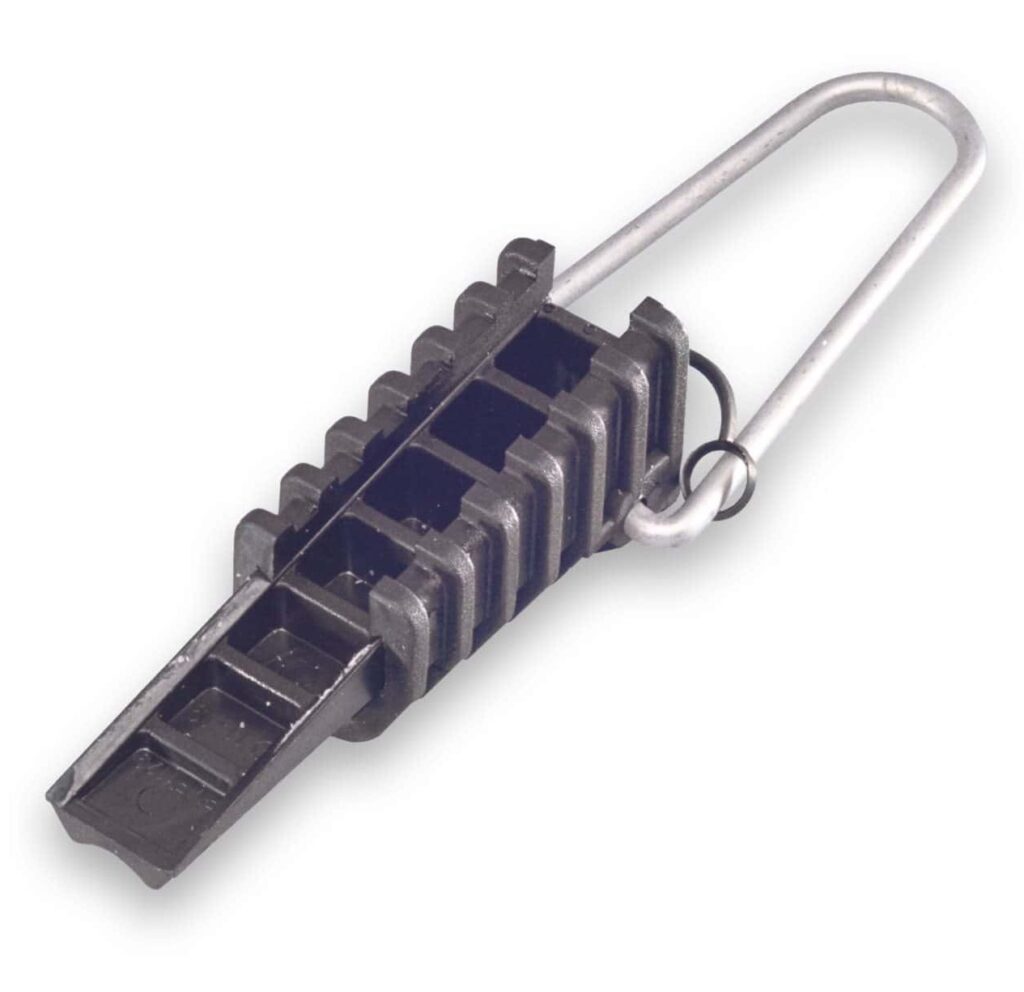
An anchor clamps is a device used in overhead power line and telecom cable installations. It secures and terminates a conductor or cable under tension. Anchor clamps holds a cable at a fixed point while withstanding mechanical loads from cable tension, wind pressure, ice loading, and thermal expansion and contraction. It prevents the conductor from slipping while maintaining the designed tension of the line. Anchor clamps grip the cable using a self-tightening mechanism. With increasing tension, the clamp applies more gripping force to ensure stability without damaging the conductor. Most anchor clamps use wedge-type gripping elements, high-strength polymer, and stainless steel bail. Anchor clamps serve in low-voltage and medium-voltage distribution lines, aerial bundled cables, and fiber optic and telecom networks. In modern grid and renewable energy expansion projects, anchor clamps ensure structural reliability and durability of the networks. Conducting quality assurance prevents sagging, mechanical failure, and outages.
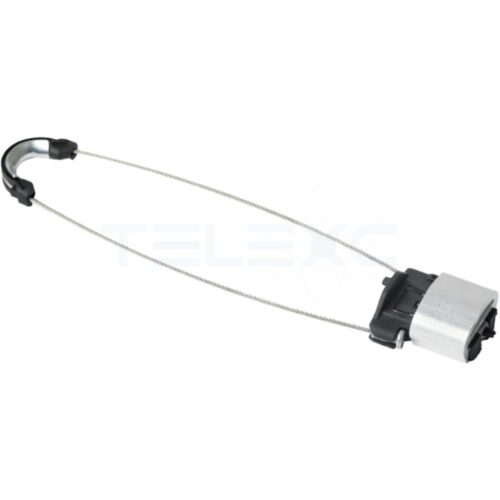
ABC Anchor Clamp 16–25 mm² | PAM Series Dead End Tension Clamp
-
Key Features
- Tool-free installation for fast and efficient setup
- High mechanical strength up to 4 kN load capacity
- UV and weather-resistant materials for long service life
- Insulation-safe gripping system prevents cable damage
- Stainless steel bail for corrosion resistance and durability
-
Allows line deviation up to:
- 50° (single anchoring)
- 100° (double anchoring)

Types of anchor clamps used in power networks
The selection of the anchor clamp depends on conductor type, mechanical load, voltage level, installation geometry, and compliance standards.
Wedge-type anchor clamps
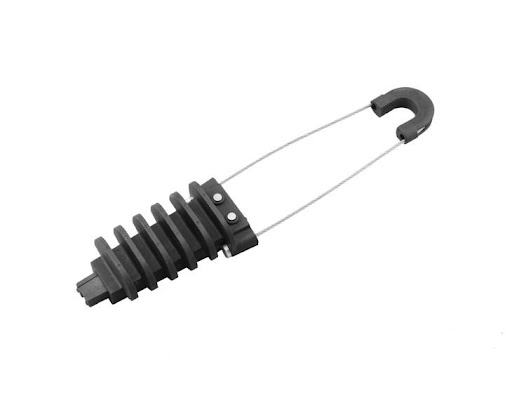
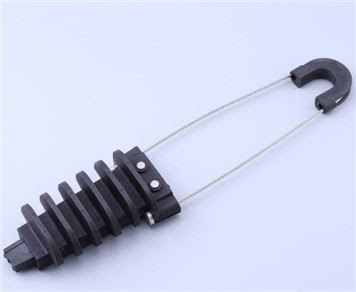
This includes the self-tightening wedges that grip the conductor as tensile load increases. It consists of polymer body, internal wedges, and stainless steel bail. Wedge-type anchor clamps offer automatic load-dependent clamping force, minimal conductor damage, and tool-free installation.
Bolted anchor clamp
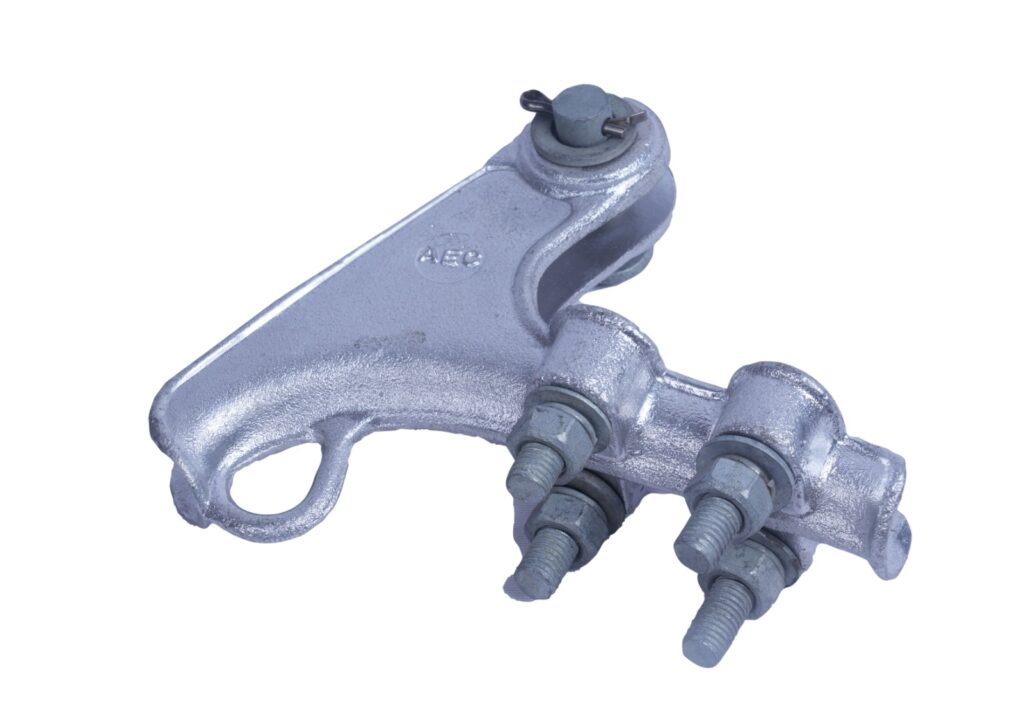
The clamping force for the clamp is applied through bolts tightened to a specified torque. It consists of cast or forged aluminum or steel body with bolting hardware. Bolted clamps offer high mechanical strength and reliability and adjustability for different conductor diameters.
Suspension-anchor hybrid clamps
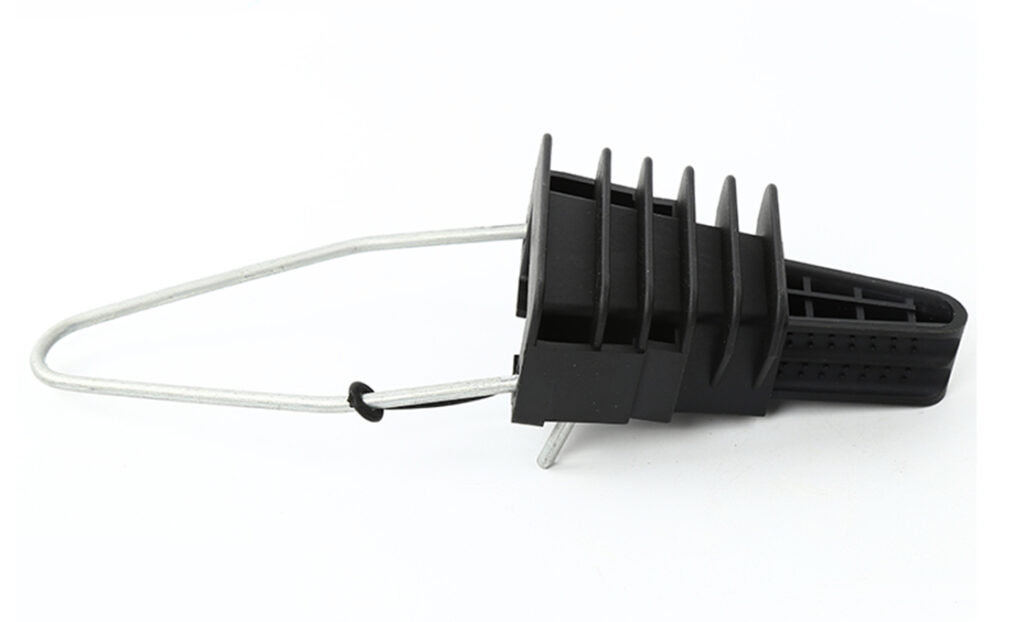
Suspension anchor clamps combine features of the suspension clamps and anchor clamps. They serve in lines with moderate angles and transitional supports between suspension and dead-end points. These clamps provide versatility in network design and reduces need for multiple clamp types.
Dead-end anchor clamps
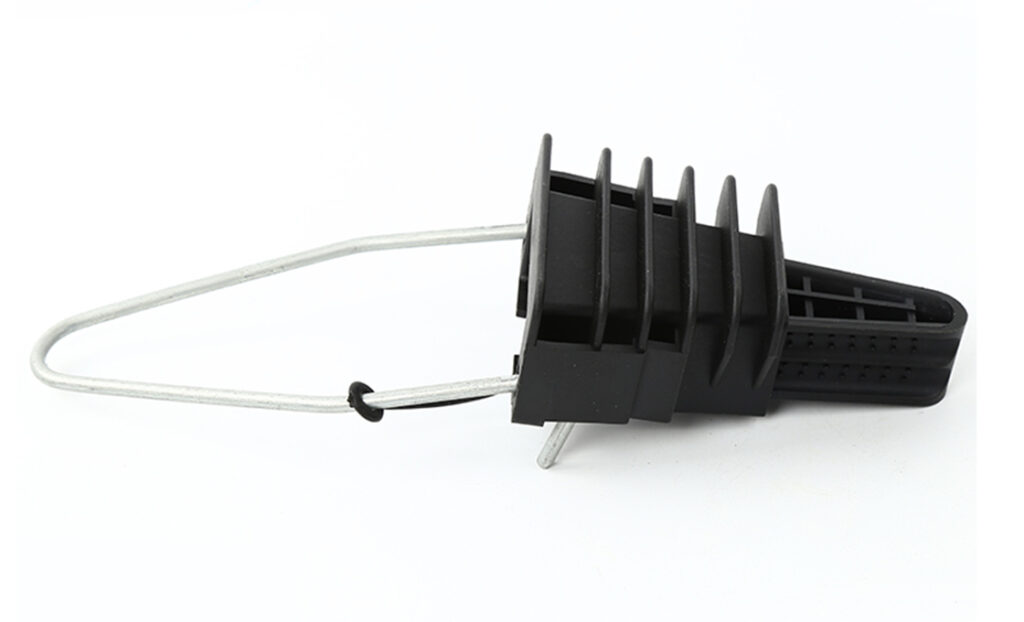
These are specifically engineered to terminate a conductor at the end of a span. It also includes a reinforced body with high load-bearing wedges or bolted grips. Deadend anchor clamps function at end of line terminations and sharp angle towers. The clamps handle tensile loads and ensure no slippage under extreme conditions.
Insulated anchor clamps
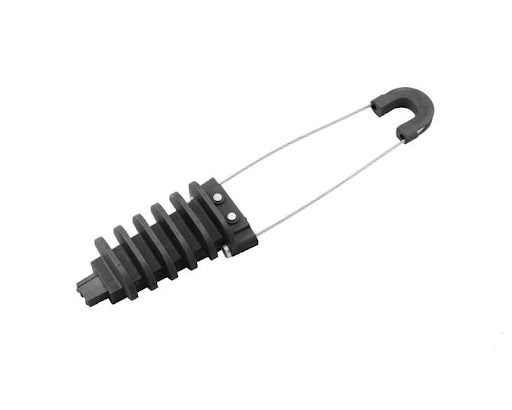
Insulated clamps provide mechanical anchoring while preserving electrical insulation. Its construction includes UV-resistant thermoplastic body with insulated wedges. They serve in aerial bundled cable systems and urban distribution networks. The clamps prevent electrical leakage and short circuits and are resistant to environmental degradation.
Preformed anchor clamps
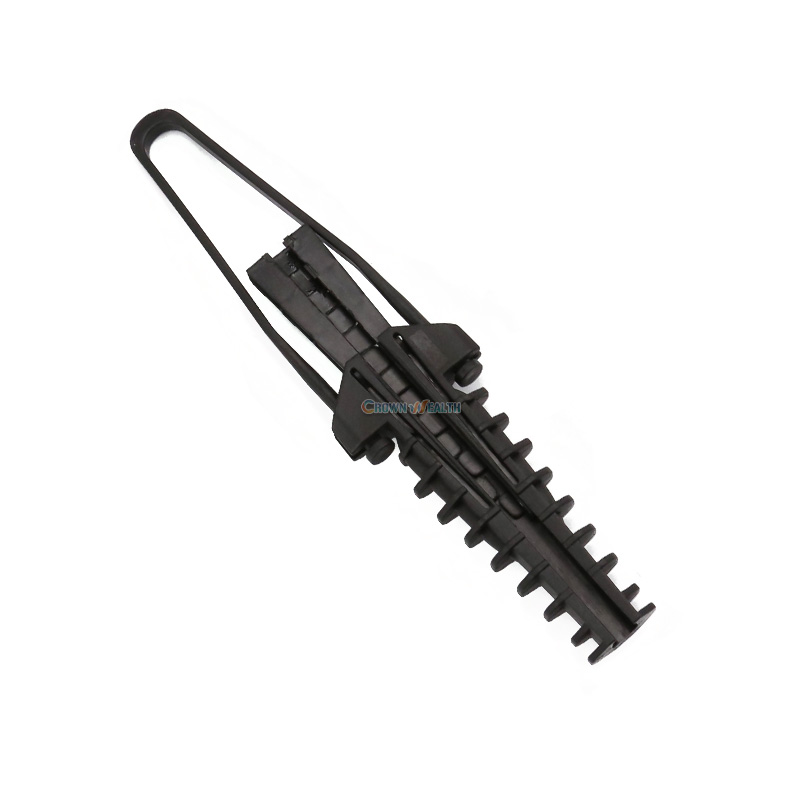
Helical clamps use preformed helical rods that wrap around the conductor and their construction includes high-strength aluminum alloy or galvanized steel helices. They serve in high-voltage transmission lines and fiber optic cables. Preformed anchor clamps offer even stress distribution along the conductor and reduces stress and fatigue.
Materials for anchor clamps and the role of quality assurance during their manufacture
Anchor clamps function under sustained mechanical tension, cyclic loading, and environmental exposure. Coupling material selection and manufacturing control prevents creep, slippage, corrosion, or brittle failure. Conducting quality assurance includes material verification, manufacturing control, tolerance inspection, mechanical performance testing, and durability testing. QA prevents failures that result in conductor drop, service interruption, or accelerated wear on adjacent hardware. QA ensures that each clamp delivers predictable mechanical performance under variable loads and harsh environments. This ensures the clamps maintain system reliability and reduce lifecycle costs. Here are the common materials for anchor clamps.
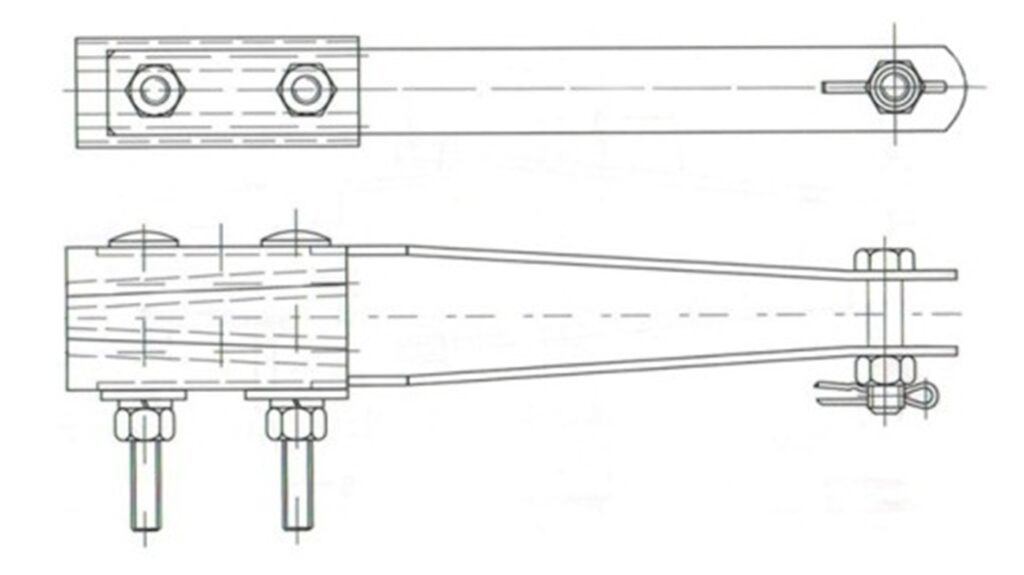
- Aluminum alloys – the alloys have high strength-to-weight ratio, good resistance to corrosion, and are compatible with aluminum conductors. Its engineering includes casting quality checks, heat treatment to achieve required mechanical properties, and surface finishing to improve corrosion resistance.
- High-strength thermoplastics – these offer electrical insulation for ABC systems, UV and weather resistance, and controlled elasticity for self-adjusting grip. Its engineering focuses on UV stabilization additives, resistance to creep under sustained load, and thermal aging performance.
- Galvanized steel – this has high tensile strength for load-bearing components and cost-effective structural reliability. Engineers should consider zinc coating thickness, hydrogen embrittlement risk, and thread integrity for bolted clamps.
- Stainless steel – this steel has superior corrosion resistance and long service life with minimal maintenance.
- Preformed helical rod materials – these materials include aluminum alloys or galvanized steel. These materials offer uniform stress distribution along conductor length and fatigue resistance in high-vibration environments.
The role of quality assurance in anchor clamp manufacturing
The quality assurance process ensures each clamp meets mechanical, environmental, and safety requirements. Quality assurance impacts reliability, failure rates, and compliance. Robust quality assurance prevents failures such as loss of tension, premature failure, and conductor slippage. These failures propagate into outages, safety incidents, and increased maintenance costs. Here are the roles of quality assurance during clamp manufacturing.
- Design validation and qualification – before production QA includes type testing, design verification, and standards alignment. This ensures the design is proven fit for purpose under diverse conditions.
- Raw material verification – material verification includes metallurgical verification, polymer validation, and supplier qualification. This process reduces substandard materials that would compromise strength.
- Process quality control – this includes forging QA that detects porosity, inclusions, and microcracks. It also includes injection molding QA that controls shrinkage and surface treatment QA that verifies galvanization thickness and adhesion.
- Dimensional accuracy and fit – anchor clamps undergo tolerance inspection that ensures correct wedge angles and assembly checks that confirms alignment between body, wedges, and bail.
- Mechanical performance testing – QA ensures the clamps perform under load through tensile load tests, slip tests, and fatigue tests.
- Environmental durability testing – QA conducts corrosion resistance tests, UV aging, and thermal cycling tests. These tests ensure long-term performance in diverse climates.
Applications of anchor clamps in energy infrastructure
Anchor clamps serve at tension-critical nodes across power and energy networks. They maintain mechanical equilibrium, preserve electrical clearances, and stabilize network geometry under variable loads. Key application areas for the anchor clamps include:
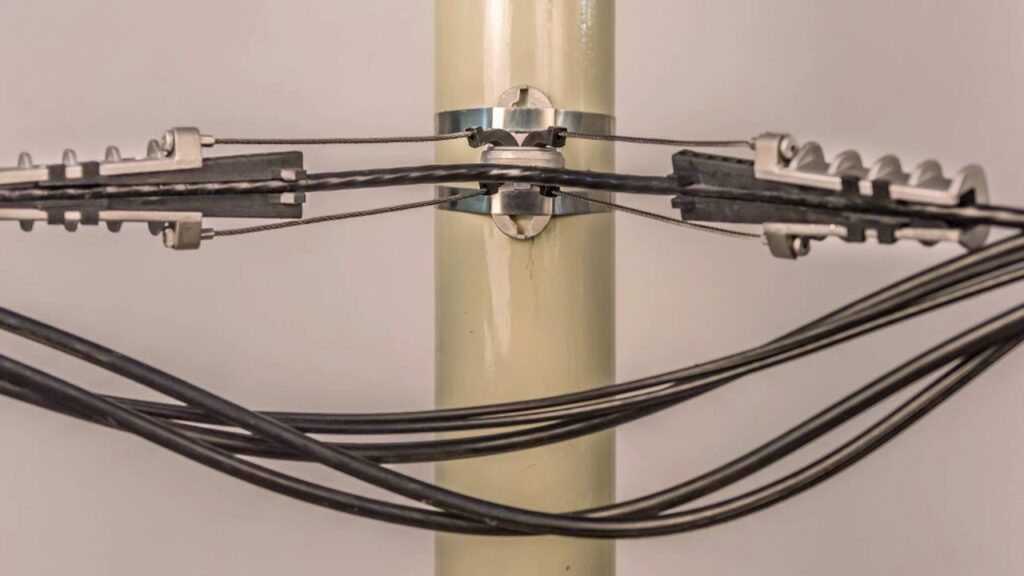
- Overhead power distribution – anchor clamps terminate conductors at poles, maintain correct sag and tension between spans, and secure service lines branching to consumers. They prevent conductor slippage and excessive sag that could lead to insulation damage or outages.
- High-voltage transmission lines – the clamps ensure structural stability under wind-induced oscillations, ice loading, and thermal expansion.
- Renewable energy integration – anchor clamps connect renewable generation assets to the grid. They serve in wind energy systems and solar PV installations. ABC clamps reduce mechanical stress on conductors.
- Substation and switching yards – anchor clamps terminate busbar conductors and secure jumpers. They maintain precise conductor positioning which helps in electrical clearance compliance and short-circuit force resistance.
- Rural electrification and grid expansion – anchor clamps support long span transmission lines with minimal infrastructure. They provide cost-effective and reliable anchoring solutions.
- Energy storage systems and hybrid grids – ABC clamps secure overhead interconnections between storage units and grid integration points. They maintain cable integrity under frequent load cycling to ensure operational stability.
- Telecom energy convergence infrastructure – anchor clamps serve in ADSS fiber cables and support dual-use corridors. They enable integrated infrastructure while maintaining mechanical independence of each cable system.
Common quality failures in anchor clamps
Anchor clamps stem from material deficiencies, process deviations, or design-application mismatches. The clamp failure leads to electrical faults, safety risks, network instability, and increased O&M costs. Combining quality assurance with correct specification and installation reduces failure risks and ensures performance in energy infrastructure. Common quality failures include:
- Insufficient mechanical strength – these failures include clamp fractures or deforms under load below its rated capacity. These failures arise from substandard aluminum alloy, casting defects, and inadequate heat treatment.
- Conductor slippage – this is where the conductor moves through the clamp under tension. The conductor moves due to poor wedge design, surface finish issues, and dimensional inaccuracies. These may lead to increased sag, clearance violations, and disconnection.
- Corrosion and surface degradation – this includes weakening due to environmental exposure from inadequate galvanization thickness and use of incompatible metals.
- Polymer degradation – these failures include cracking, embrittlement, or creep in thermoplastic components. These arise from low-grade polymer, poor injection molding control, and exposure to heat.
- Thermal expansion and creep issues – this is the gradual loss of grip to material deformation over time. This arises from polymer creep under sustained load and different expansion coefficients.
Best practices for selecting the right anchor clamp
It is crucial to consider mechanical loading, conductor characteristics, environmental exposure, and compliance constraints when selecting an anchor clamp. Key practices include matching the clamp to conductor type, verifying dimensional compatibility, considering installation geometry, assessing environmental conditions, evaluating installation method constraints, and checking material quality. The correct anchor clamp meets mechanical load requirements, is material-compatible with the conductor, has verified performance through testing, and can be installed reliably under field conditions.