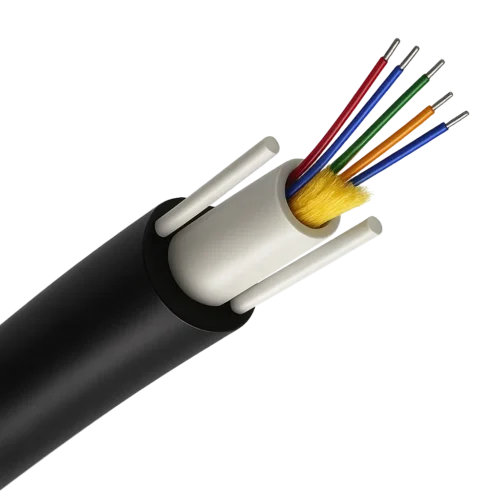
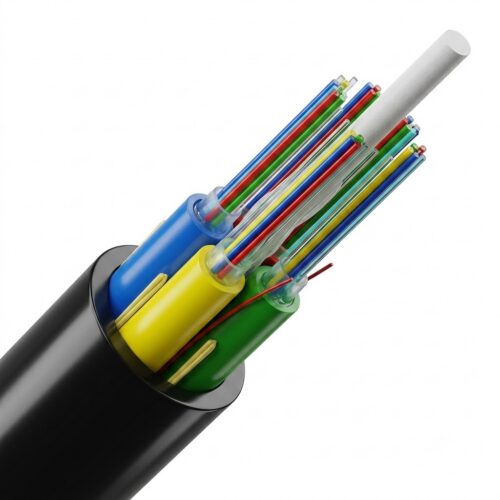
| General Specifications | |
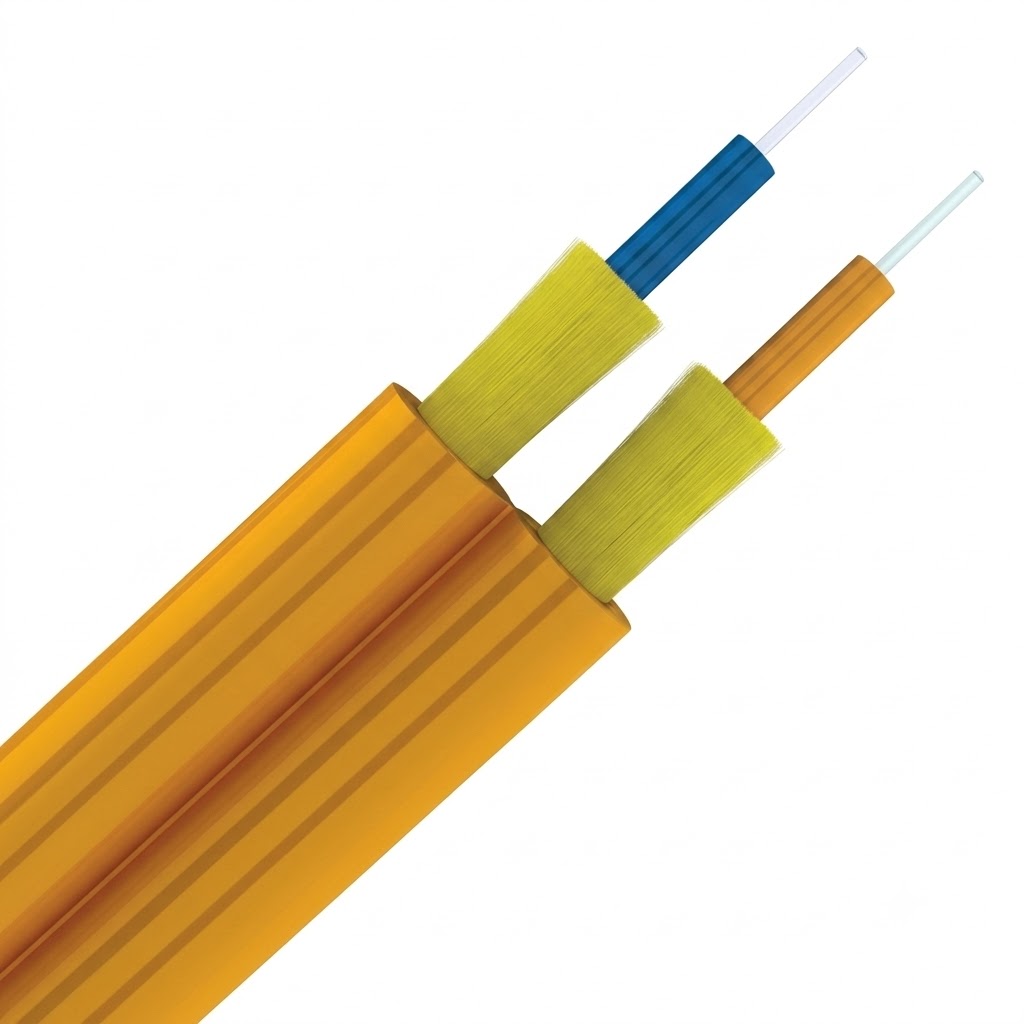
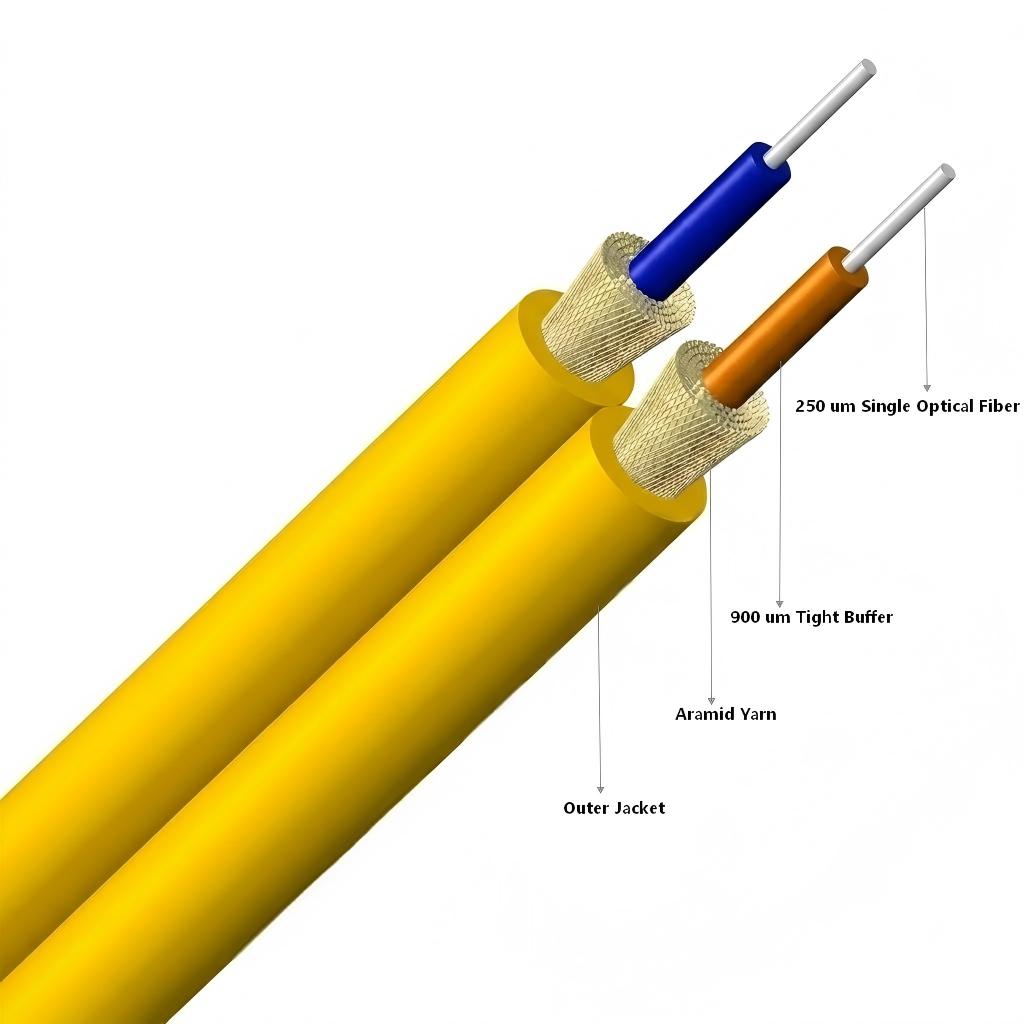
| Product type | Fiber Indoor Cable,Duplex tight-buffered zipcord |
| Construction Type | Non-armored |
| Fiber Coloring | White |
| Jacket Marking | Feet/Meter |
| Subunit Type | Gel-free |
| Total Fiber Count | 2 |
| Dimensions | |
| Diameter Over Jacket | 2.9 mm*5.9mm | 0.114 in*0.232in |
| Mechanical Specifications | |
| Max. Tensile Strength, Long-Term | 120 N | 26.977 lbf |
| Max. Tensile Strength, Short-Term | 400 N | 89.924 lbf |
| Minimum Bend Radius, loaded | 44 mm | 1.732 in |
| Minimum Bend Radius, unloaded | 23 mm | 0.906 in |
| Compression | 10 N/mm | 57.101 lb/in |
| Flex | 30 cycles |
| Impact | 0.74 N-m | 6.55 in lb |
| Twist | 10 cycles |
| Vertical Rise, maximum | 500 m | 1,640.42 ft |
| Optical Specifications | |
| Fiber Type | Multimode 50um OM4/OM3 |
| Attenuation, maximum | 2.8 dB/km@850nm /1.0 dB/km@1300nm |
| Fiber Core Diameter | 50 µm |
| Serial 1 Gigabit Ethernet | 1000 m / 600 m |
| Serial 10 Gigabit Ethernet | 550 m / – |
| Minimum Effective Modal Bandwidth (EMB) | 4700 MHz*km / – |
| Min. Overfilled Launch (OFL) Bandwidth | 3500 MHz*km / 500 MHz*km |
| Environmental Specifications | |
| Installation temperature | -30 °C to +70 °C (-22 °F to +158 °F) |
| Operating Temperature | -40 °C to +70 °C (-40 °F to +158 °F) |
| Storage Temperature | -40 °C to +75 °C (-40 °F to +167 °F) |
| Cable Qualification Standards | ANSI/ICEA S-87-640 | IEEE-1222 |
| Environmental Test Specifications | |
| Cable Freeze | -2 °C | 28.4 °F |
| Drip | 80 °C | 176 °F |
| Heat Age | -40 °C to +85 °C (-40 °F to +185 °F) |
| Low High Bend | -30 °C to +60 °C (-22 °F to +140 °F) |
| Temperature Cycle | -40 °C to +70 °C (-40 °F to +158 °F) |
| Packaging and Weights | |
| Cable weight | 18 kg/km | 12.095 lb/kft |
Fiber Indoor Cable,Duplex tight-buffered zipcord
Q1: What type of optical fiber is used in this cable, and what is its maximum attenuation?
A: This simplex cable features a dual-standard single-mode fiber core compliant with both G.652.D and G.657.A1 standards. The inclusion of G.657.A1 ensures superior bend-insensitive performance for sharp indoor routing. The maximum attenuation coefficients across key operating wavelengths are tightly controlled:
-
≤ 0.36 dB/km @ 1310 nm
-
≤ 0.36 dB/km @ 1385 nm
-
≤ 0.25 dB/km @ 1490 nm
-
≤ 0.22 dB/km @ 1550 nm
-
≤ 0.25 dB/km @ 1625 nm
Q2: What are the specified minimum bend radii for installation and operation?
A: To safeguard the fiber from micro-bending attenuation and physical stress, the cable must strictly adhere to the following bend radius thresholds:
-
Loaded (During Dynamic Installation): Minimum bend radius is 44 mm (1.732 in).
-
Unloaded (Static Long-Term Operation): Minimum bend radius is 23 mm (0.906 in).
Q3: What is the maximum mechanical pulling tension allowed? A: Reinforced with high-modulus aramid yarn (Kevlar) as the primary strength member, the cable delivers robust tensile protection:
-
Short-Term Tensile Strength (Installation): Max. 267 N (60.024 lbf).
-
Long-Term Tensile Strength (Operation): Max. 80 N (17.985 lbf). Note: Due to its light-duty design for indoor interconnects, steady manual pulling is highly recommended over aggressive mechanical hauling.
Q4: What are the outer diameter and shipping weight specifications?
A: This cable features a highly compact and lightweight architecture, optimizing pathway utilization and freight costs:
-
Diameter Over Jacket: Nominally 2.9 mm (0.114 in).
-
Nominal Cable Weight: 9 kg/km (6.048 lb/kft).
Q5: What are the thermal operating limits for this cable? A: Engineered with a premium Riser-rated, Low Smoke Zero Halogen (LSZH) jacket, the cable maintains outstanding structural stability across extreme temperature ranges:
-
Installation Temperature Range: -30 °C to +70 °C (-22 °F to +158 °F)
-
Operating Temperature Range: -40 °C to +70 °C (-40 °F to +158 °F)
-
Storage Temperature Range: -40 °C to +75 °C (-40 °F to +167 °F)
-
Cable Freeze Standard Test: Compliant down to -2 °C (28.4 °F)

Engineered for Reliability, Built for Trust
At Telexc, we don’t just supply hardware—we secure your global network deployment. Operating from China’s premier industrial clusters and the Tianjin logistics hub, we act as your private supply chain control tower, ensuring engineering precision and traceably consistent quality for every aerial installation.
Our Core Advantages
- Full-Scenario Aerial Compatibility: We seamlessly bridge the gap between OSP fiber infrastructure, FTTH networks, and aerial deployment scenarios. Every component is structurally engineered to work harmoniously together, drastically increasing on-site installation efficiency.
- Strict Engineering Standard Alignment: Our technical design loops strictly align with international benchmarks, including IEC, ITU-T, and IEEE standards. This ensures our hardware excels under extreme environmental stresses—from intense UV exposure to heavy wind and ice loads.
- Independent Multi-Stage Quality Control: We act as your eyes on the ground. From raw material stress simulations to finished product compliance, our dedicated QC team performs rigorous multi-stage audits so you receive exactly what your engineers approved.
- Optimized Logistics & Flexible Partnerships: Leveraging the logistics power of the Tianjin port, we guarantee reliable transit, competitive factory-direct structures, and transparent milestone tracking to keep your network projects moving forward without compromise.
- FTTH & FTTx subscriber network connections
- ODF connections
- Distribution network
- Pre-terminated or field-installable systems
- Inside house OLT connection