
Direct Buried Optical Fiber Cables
Direct burial fiber optic cable is a ruggedized outdoor cable designed to be laid directly into the soil without the protection of conduit or ducting.
… Load moreShowing all 5 results
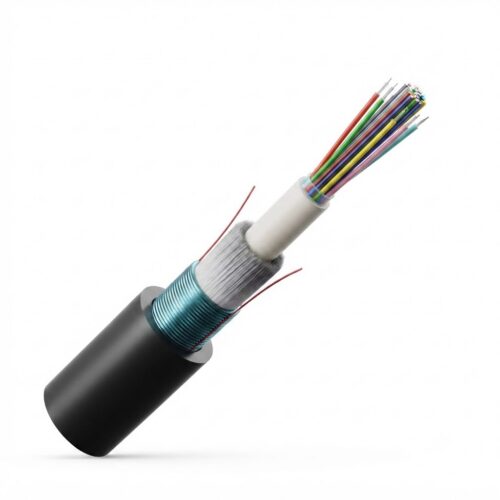
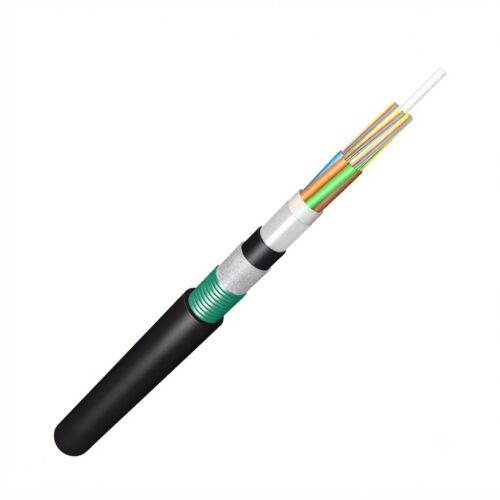
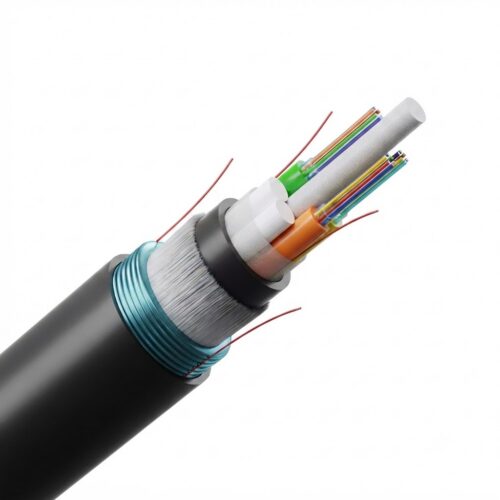
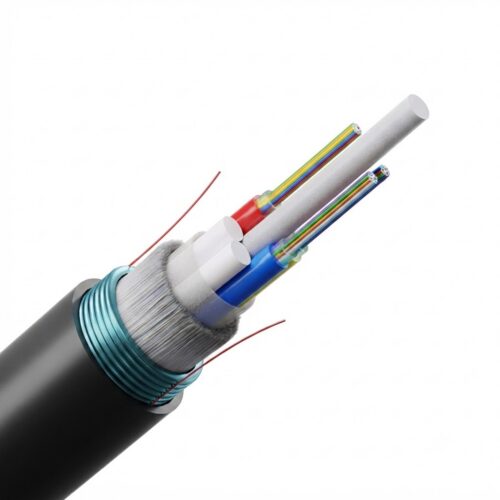
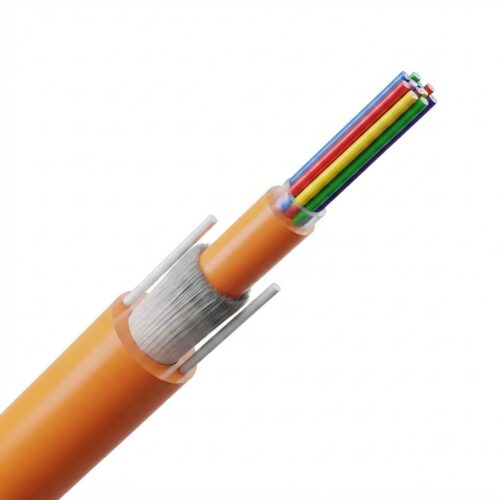
It is not a slightly reinforced patch cord; it is a communications backbone systematically engineered to survive the "Four Underground Killers": soil pressure, groundwater ingress, rodent attacks, and ground movement.
How It Differs from Standard Fiber Cables
Standard indoor or aerial cables are built for gentle, controlled environments. Their thin jackets, lack of armor, and zero waterproofing mean they will fail within months if buried—water seeps in, causing signal loss, while soil compression crushes the delicate glass fibers. A direct burial cable, by contrast, employs a fortress-like multi-layer defense, enabling the fragile glass core to reliably carry data for over 25 years underground.
Anatomy of Protection (From Core to Jacket)
A direct burial cable has a highly specialized structure:

Central Strength Member: Typically an FRP (Fiber Reinforced Plastic) rod or a steel wire, this acts as the "spine," absorbing pulling tension during installation and providing longitudinal stability.
Loose Tubes & Water-Blocking Gel: The color-coded optical fibers float inside PBT loose tubes filled with thixotropic gel. This design gives the fibers a slight excess length, fully isolating them from mechanical stress and moisture.
The Armor Layer (The Shield): This is the core defense. Depending on the protection level, it can be corrugated steel tape, steel wires, or high-strength glass yarns. It resists rodent bites, crushing forces, and excavation impacts.
Inner & Outer Polyethylene (PE) Jackets: Made of High-Density Polyethylene (HDPE), the jackets provide extreme abrasion, chemical, and UV resistance. A double-jacket structure offers redundant protection against the harshest soils.
This integrated design—a strong spine, loose gel-filled chambers, and a thick armored skin—makes the direct burial cable the undisputed workhorse of terrestrial communication.
What are the main advantages of direct-buried fiber cables?
Direct burial is the ideal solution for projects that lack existing conduit, require long-haul connections, and demand minimal lifetime maintenance. Its typical applications include:
-
Rural & Remote FTTH (Fiber to the Home): In scattered villages, trenching and direct burial is far more economical than laying miles of conduit.
-
Campus & Industrial Park Backbones: Quickly connect buildings across lawns, under roads, and around facilities without costly duct construction.
-
Right-of-Way Communications: Bury directly along highways, railways, and riverbanks, where the cable must endure significant environmental stress.
-
Rodent & Rocky Terrain: Specialized armor actively defends against rodents and sharp rocks, ensuring link survivability.
-
Power Utility Areas (All-Dielectric): Near substations and high-voltage corridors, non-metallic cables eliminate the risk of lightning strikes and induced electrical surges.
Direct Burial vs. Conduit Burial: Which Is Better?
Not all buried fiber is the same. Understanding the difference prevents investment mistakes:
| Comparison Point | Direct Burial Cable | Conduit Burial (Cable inside a duct) |
|---|---|---|
| Installation | One-step: dig, sand, lay cable, backfill. | Two-step: dig, lay duct, backfill, then pull/blow cable. |
| Initial Cost | Lower. No conduit material or extra labor. | Higher. Requires duct, trenching, and pulling equipment. |
| Physical Protection | The cable is the protection—provided you choose the right type. | The duct is the first barrier; you can use a lighter, cheaper cable. |
| Future-Proofing | Poor. Upgrading requires a new trench. | Excellent. You can pull out the old cable and blow in a new one without digging. |
| Best For | Fixed routes, one-time builds where long-term reliability is the goal. | Areas with frequent upgrades, under roads, or where future expansion is uncertain. |
The Golden Rule: If the route is permanent and reliability is paramount, choose direct burial. If your network is likely to grow and change, investing in conduit is the more future-proof choice.
Installation Pitfalls to Avoid: Rules for a 25-Year Lifespan
Even the most expensive, sturdiest cable will fail prematurely if installed roughly. Make these non-negotiable engineering rules your absolute baseline:
1. Depth Is Non-Negotiable
-
Under non-traffic areas (lawns, fields): minimum 60 cm (24 inches).
-
Under roads, driveways, or parking lots: at least 90 cm (36 inches).
-
Anything shallower leaves the cable vulnerable to gardening, frost heave, and vehicle loads.
2. The Sand Bed Is Sacred (Especially in Rocky Soil)
-
Line the trench bottom with a 10 cm (4-inch) layer of sand or fine soil before laying the cable. Cover the cable with another 10 cm of sand before backfilling.
-
This cushion is the only thing that prevents sharp stones from piercing the HDPE jacket under pressure. Skipping this step in rocky ground is a guaranteed failure.
3. Warning Tape: A Message to the Future
-
Place a detectable warning tape about 30 cm (12 inches) above the cable’s sand cover. The tape must have a metallic tracer wire.
-
It must read clearly: "CAUTION: FIBER OPTIC CABLE BELOW." This is the final warning for anyone digging there in the future and allows utility locators to find the cable easily.
4. Respect the Bend Radius
-
The dynamic bend radius during pulling must be 20 times the cable's outer diameter. The static bend radius after installation should be 10 times.
-
A single kink or sharp bend will snap the internal glass fibers instantly, with no visible damage to the outer jacket.
5. Grounding Is Mandatory for Metallic Cables
-
If you use a metallic-armored cable like GYTA53 or GYTA33, you must ground it properly at both ends and at all splice points.
-
In high lightning areas or parallel runs near power lines, save yourself the risk entirely by switching to an all-dielectric cable (GYFTY53).
6. Extreme Rodent & Chemical Defense
-
Rodents: Even with steel armor, severe infestations may require adding a rodent repellent to the sand bedding or placing a concrete cover slab above the cable.
-
Chemicals: In industrial zones, saline-alkali land, or heavily fertilized farmland, confirm the HDPE jacket’s chemical resistance grade with the manufacturer. A special compound may be needed.
7. Never Enter a Building Directly
-
A direct burial cable contains metal and gel and does not meet indoor fire safety codes (it lacks CMR/CMP fire ratings).
-
You must transition at the building entry point. Use a splice box to connect the outdoor direct burial cable to an indoor-rated flame-retardant cable before the cable enters the wall. This is a hard safety requirement.
Product Series Guide & Quick Selector
With the fundamentals understood, you can now match the cable to your project's specific threats and budget from our four core series:
1. Steel Tape Armor, Double Jacket Series
Representative Model: GYTA53
-
Core Build: Aluminum moisture barrier + Corrugated steel tape armor + Double PE jacket.
-
In a Nutshell: The universal standard. Unmatched balance of crush resistance, waterproofing, and cost-effectiveness for general direct burial.
-
Key Strengths: Superior rodent and crush resistance, dual water blocking, 25+ year lifespan.
-
Typical Use: Campus backbones, rural FTTH, standard soil burial, roadside laying.
2. Steel Wire Armor, Heavy-Duty Series
Representative Model: GYTA33
-
Core Build: Aluminum moisture barrier + Fine round steel wire armor + Double PE jacket.
-
In a Nutshell: The "submersible warrior" built for extreme tension and crushing loads. Designed for river crossings and heavy-traffic zones.
-
Key Strengths: Vastly superior tensile strength, resists heavy excavator impact, can be laid in shallow water or riverbeds.
-
Typical Use: River/lake crossings, steep mountain slopes, under heavy-duty roads, mining areas.
3. All-Dielectric, Non-Metallic Lightning-Proof Series
Representative Model: GYFTY53
-
Core Build: FRP central member + Glass yarn armor + Double PE jacket. Zero metal.
-
In a Nutshell: The inherently safe solution. Immune to lightning and electromagnetic interference, making it the only choice near power infrastructure.
-
Key Strengths: Completely eliminates lightning induction, pure signal transmission, lightweight, corrosion-proof.
-
Typical Use: Near substations, HV power line co-trenching, high lightning areas, railway lines.
4. Light Armor, Conduit & Shallow-Trench Series
Representative Model: GYTS
-
Core Build: Single-layer corrugated steel tape armor + Single PE jacket (no inner aluminum moisture barrier).
-
In a Nutshell: The high-efficiency, cost-optimized workhorse for in-conduit installation and protected shallow trenches.
-
Key Strengths: Small diameter, flexible and easy to pull, lowest cost. Provides adequate protection inside a duct.
-
Typical Use: Pulling into HDPE ducts or inner ducts, protected cable troughs, shallow garden burial, routes that will be upgraded periodically.
Rapid Selection Decision Tree:
-
Standard direct burial, no special threats? → GYTA53
-
Need to cross a river, steep slope, or under heavy vehicles? → GYTA33
-
Near high-voltage electricity, a substation, or frequent lightning? → GYFTY53
-
Have existing conduit and want a cost-effective, replaceable solution? → GYTS
For detailed specifications, custom fiber counts, or a sample request, contact our technical consultants. We'll help you navigate these pitfalls one-on-one to secure your project's physical layer.