| General Specifications | |||||
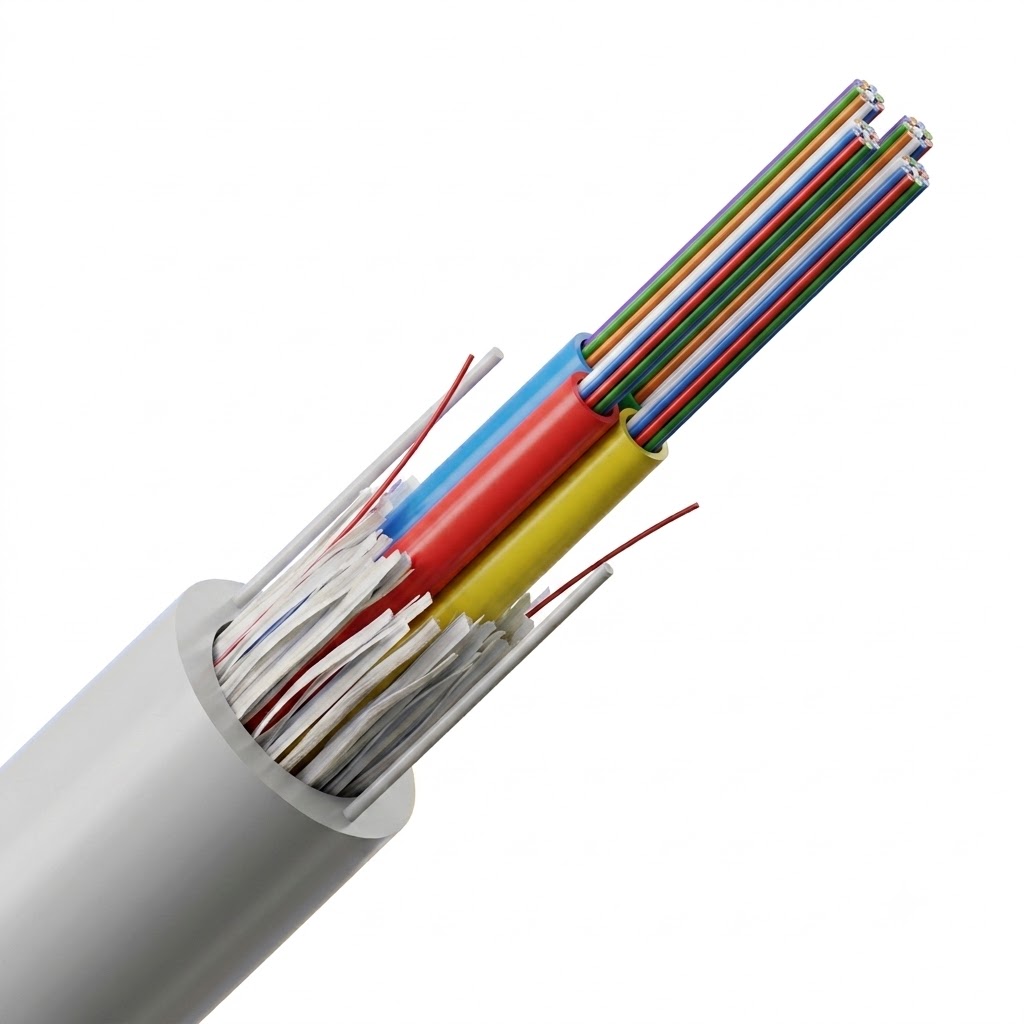
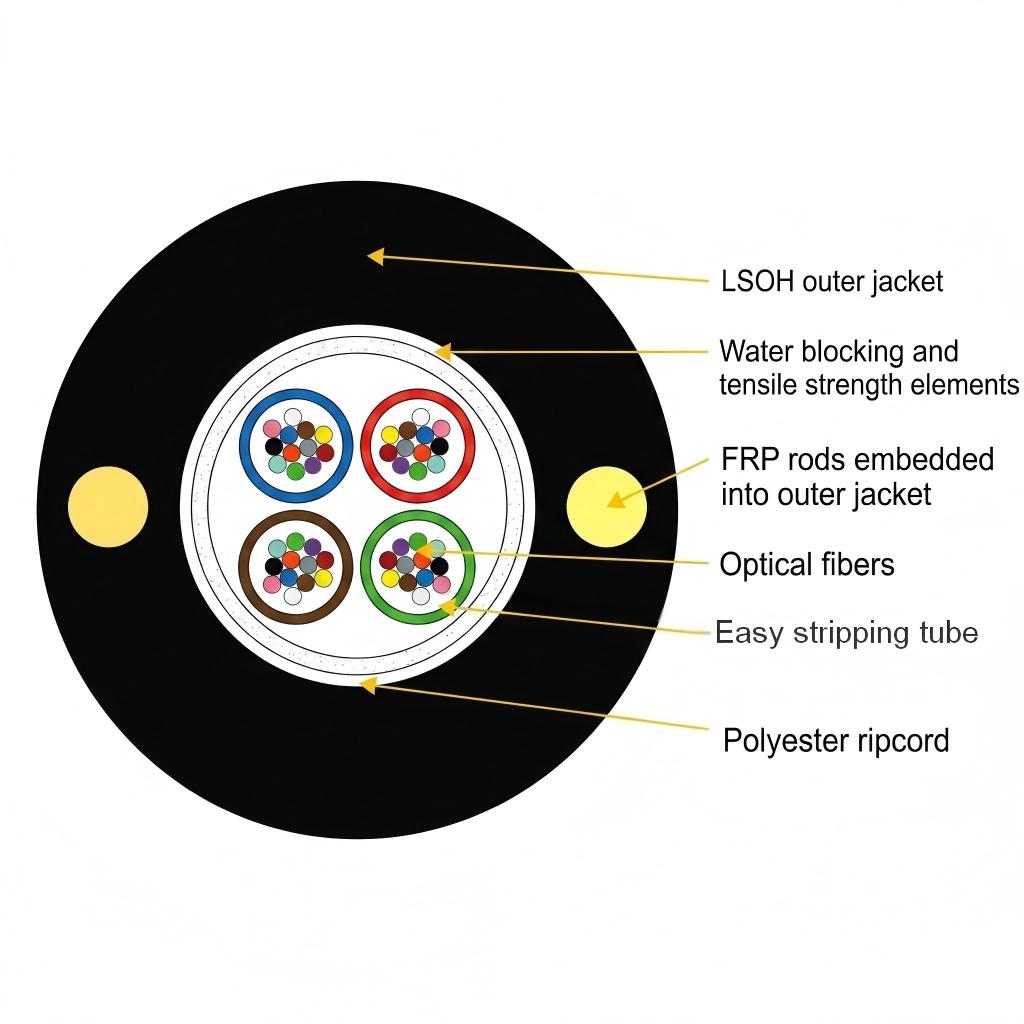
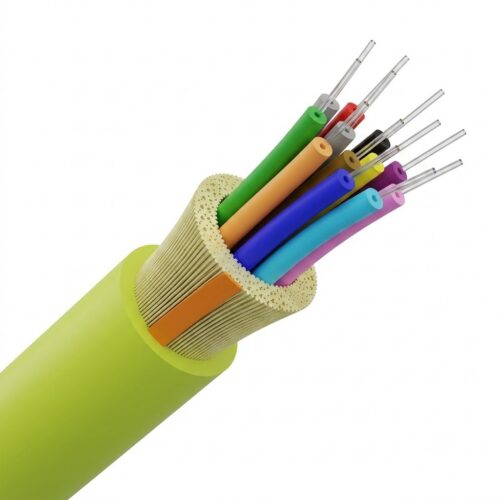
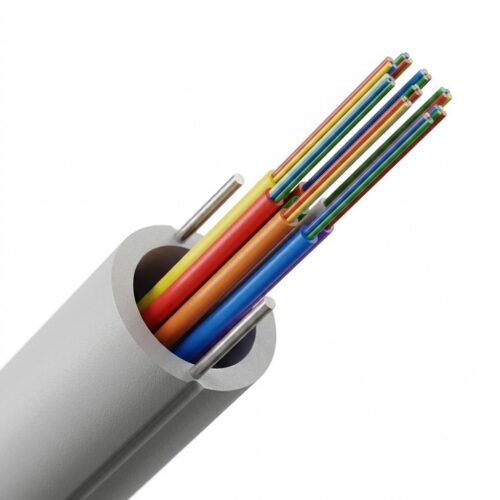
| Product type | Indoor LSOH Micromodule Fiber Optic Cable (Gel-Free) | ||||
| Jacket Material | LSOH outer jacket | ||||
| Jacket Marking | Feet/Meter | ||||
| Subunit Type | Gel-free | ||||
| Fiber Coloring | Blue, Orange, Green, Brown, Slate, White, Red, Black, Yellow,Violet, Rose, Aqua | ||||
| Fiber per tube | 6 | ||||
| Active tube | 1-24 | ||||
| Total Fiber Count | 6-24 | 36 | 48 | 72-96 | 144 |
| Dimensions | |||||
| Diameter Over Jacket | 7.0 mm (0.276 in) | 7.9 mm (0.311 in) | 9.0 mm (0.354 in) | 10.2 mm (0.402 in) | 11.5 mm (0.453 in) |
| Mechanical Specifications | |||||
| Minimum Bend Radius, unloaded | 37mm (1.457 in) | 46 mm(1.811 in) | 51 mm(2.008 in) | 56 mm(2.205 in) | 61 mm( 2.402 in) |
| Minimum Bend Radius, loaded | 56 mm(2.205 in) | 70 mm(2.756 in) | 76 mm(2.992 in) | 84 mm(3.307 in) | 91 mm(3.583 in) |
| Tensile Load, Installation, maximum | 800 N (180 lbf) | 1000 N (225 lbf) | 1100 N (247 lbf) | 1600 N (360 lbf) | 1900 N (427 lbf) |
| Tensile Load, Operation, maximum | 270 N (61 lbf) | 350 N (79 lbf) | 370 N (83 lbf) | 500 N (112 lbf) | 600 N (135 lbf) |
| Compression | 10 N/mm | 57.101 lb/in | ||||
| Flex | 30 cycles | ||||
| Impact | 2.94 N-m | 26.021 in lb | ||||
| Twist | 10 cycles | ||||
| Optical Specifications, Wavelength Specifications | |||||
| Fiber Type | G.652.D and G.657.A1 | ||||
| Attenuation, maximum | 0.3 dB/km @ 1,550 nm | 0.4 dB/km @ 1,310 nm | ||||
| Environmental Specifications | |||||
| Installation temperature | -5 °C to +60 °C (+23 °F to +140 °F) | ||||
| Operating Temperature | -30 °C to +60 °C (-22 °F to +140 °F) | ||||
| Storage Temperature | -40 °C to +70 °C (-40 °F to +158 °F) | ||||
| Cable Qualification Standards | ANSI/ICEA S-87-640 | IEEE-1222 | ||||
| Packaging and Weights | |||||
| Cable weight | 54 kg/km (36.286 lb/kft) | 59 kg/km (39.646 lb/kft) | 73 kg/km (49.054 lb/kft) | 94 kg/km (61.821 lb/kft) | 108 kg/km( 22.847 lb/kft) |
Indoor LSOH Micromodule Fiber Optic Cable (Gel-Free)
- Indoor Building Backbone & Distribution
Designed for high-density vertical (riser) and horizontal cabling inside residential and commercial buildings. The compact outer diameter and lightweight structure make it easy to route through crowded cable trays and conduit risers.
- Fast & Mess-Free FTTH Splicing
Features Easy Section Module™ (ESM) technology with a 100% dry design (no filling gel). Field technicians can access optical fibers without special tools or cleaning solvent, dramatically cutting down termination time at building entry points or distribution frames.
- Microduct Cable Blowing & Upgrades
Optimized for installation into existing underground microducts or sub-ducts. The low-friction jacket and flexible micromodule structure allow for smooth cable blowing or pulling during network capacity expansion.
- CPR & Fire Safety Compliance
Encased in a Low Smoke Zero Halogen (LSOH) outer jacket, making it compliant with strict CPR fire safety standards. Perfect for fire-sensitive infrastructure such as airports, data centers, hospitals, and public transport hubs.
Q1. What is an Indoor Gel-Free Micromodule Fiber Cable?
An indoor gel-free micromodule cable features flexible, ultra-thin micro-tubes (micromodules) containing optical fibers, utilizing dry water-blocking materials instead of traditional petroleum gel. This design creates a lighter, smaller-diameter cable that is cleaner to work with and optimized for high-density FTTH and riser networks.
Q2. What are the key benefits of a gel-free (dry) cable design during installation?
-
Faster Cable Prep: Removes the need to wipe away messy gel with chemical solvents, reducing fiber preparation time by up to 50% – 70%.
-
Tool-Free Fiber Access: Flexible micromodules can easily be stripped by hand without specialized tools, eliminating the risk of micro-cracks or accidental fiber damage caused by stripping pliers.
-
Cleaner Work Environment: Eliminates chemical residues, ensuring a neat installation in indoor floor boxes, ODFs, and customer premises.
Q3. What type of fiber is typically used inside micromodule cables?
These cables typically incorporate bend-insensitive single-mode fibers compliant with ITU-T G.657.A1 or G.657.A2 standards. This allows for tight bending radii (as low as 7.5 mm to 10 mm) without causing significant signal attenuation, making them ideal for tight turns in indoor conduits and distribution boxes.
Q4. What are the fire safety and jacket specifications for indoor applications?
Indoor micromodule cables feature LSZH / LSOH (Low Smoke Zero Halogen) outer jackets. In the event of a fire, they emit minimal smoke and zero toxic halogen gases, complying with international flame retardancy standards such as IEC 60332 and European CPR (Construction Products Regulation) requirements.
Q5. How reliable is water blocking in a dry, gel-free cable?
Gel-free micromodule cables use Super Absorbent Polymer (SAP) yarns or tapes instead of gel. When exposed to moisture, these dry materials swell instantly to form a water-proof barrier that blocks water penetration, fully meeting IEC 60794 water-blocking performance standards.
Q6. Is fusion splicing compatible with micromodule fiber?
Yes. Because the fibers inside the micromodules feature standard 250 micron (250 um) primary coating dimensions and are completely free of gel, they require no solvent cleaning and can be cleaved and spliced immediately using any standard fusion splicer and heat-shrink protection sleeves.

Engineered for Reliability, Built for Trust
At Telexc, we don’t just supply hardware—we secure your global network deployment. Operating from China’s premier industrial clusters and the Tianjin logistics hub, we act as your private supply chain control tower, ensuring engineering precision and traceably consistent quality for every aerial installation.
Our Core Advantages
- Full-Scenario Aerial Compatibility: We seamlessly bridge the gap between OSP fiber infrastructure, FTTH networks, and aerial deployment scenarios. Every component is structurally engineered to work harmoniously together, drastically increasing on-site installation efficiency.
- Strict Engineering Standard Alignment: Our technical design loops strictly align with international benchmarks, including IEC, ITU-T, and IEEE standards. This ensures our hardware excels under extreme environmental stresses—from intense UV exposure to heavy wind and ice loads.
- Independent Multi-Stage Quality Control: We act as your eyes on the ground. From raw material stress simulations to finished product compliance, our dedicated QC team performs rigorous multi-stage audits so you receive exactly what your engineers approved.
- Optimized Logistics & Flexible Partnerships: Leveraging the logistics power of the Tianjin port, we guarantee reliable transit, competitive factory-direct structures, and transparent milestone tracking to keep your network projects moving forward without compromise.