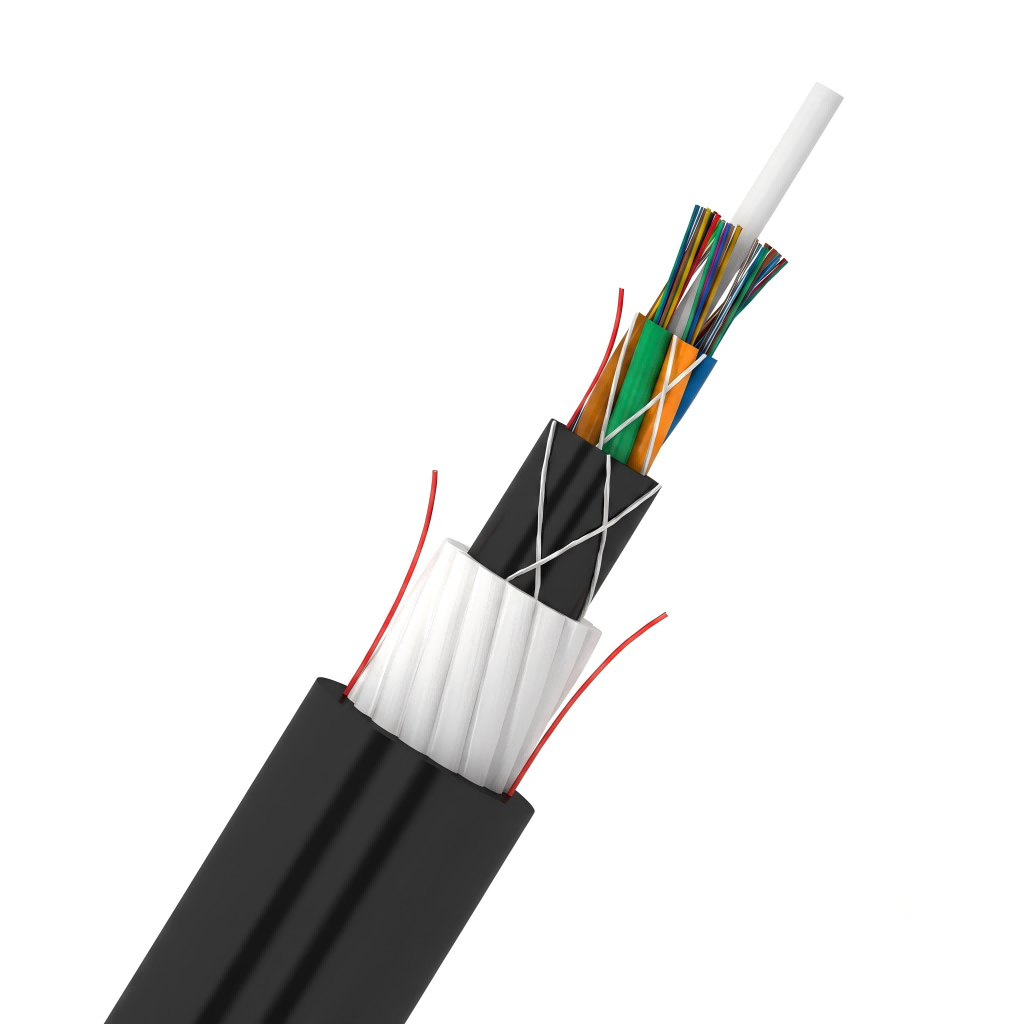
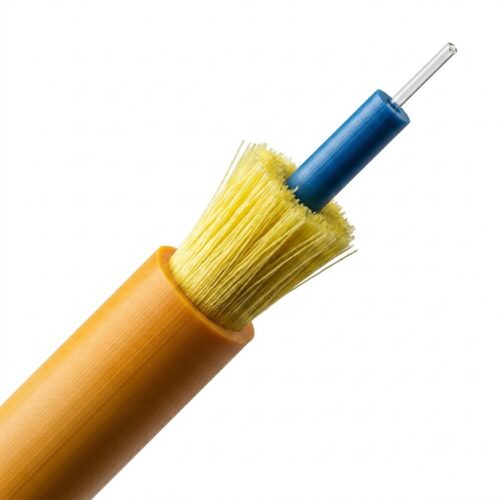
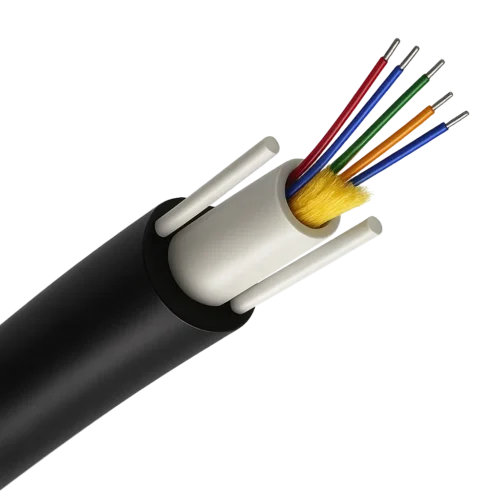
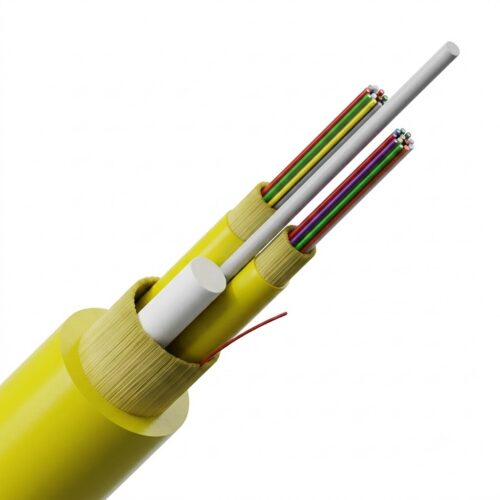
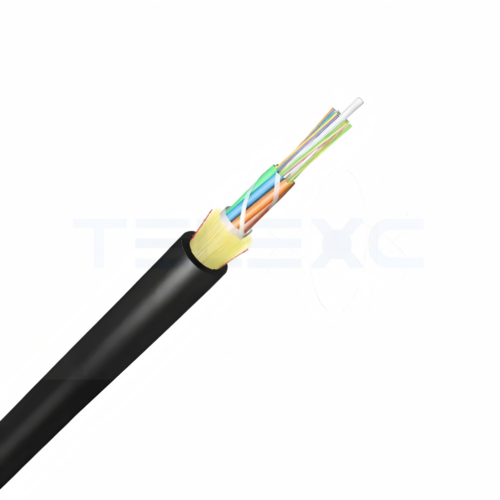
Anti-Squirrel ADSS Fiber Optic Cable delivers a premium, all-dielectric, self-supporting solution engineered specifically for aerial installations in campus backbones and OSP distribution networks(typically on roadside power distribution poles).This Anti-Squirrel ADSS Optical Cable is an all-dielectric non-metallic structure. It uses high-strength glass fiber reinforced plastic to form an extremely strong and effective anti-squirrel protective layer. Through structural optimization, the weight of the optical cable and its mechanical and physical properties are reasonably configured, while minimizing the impact on the tower. load.Being totally non-metallic, this product is ideal for applications in close proximity to power distribution lines. This product is also suited to single point suspension applications where the product has to support either a higher load than conventional terrestrial cable or a permanent or varying tensile load, applied through the outer sheath. Standard pole-mounting hardware is readily available for this product.
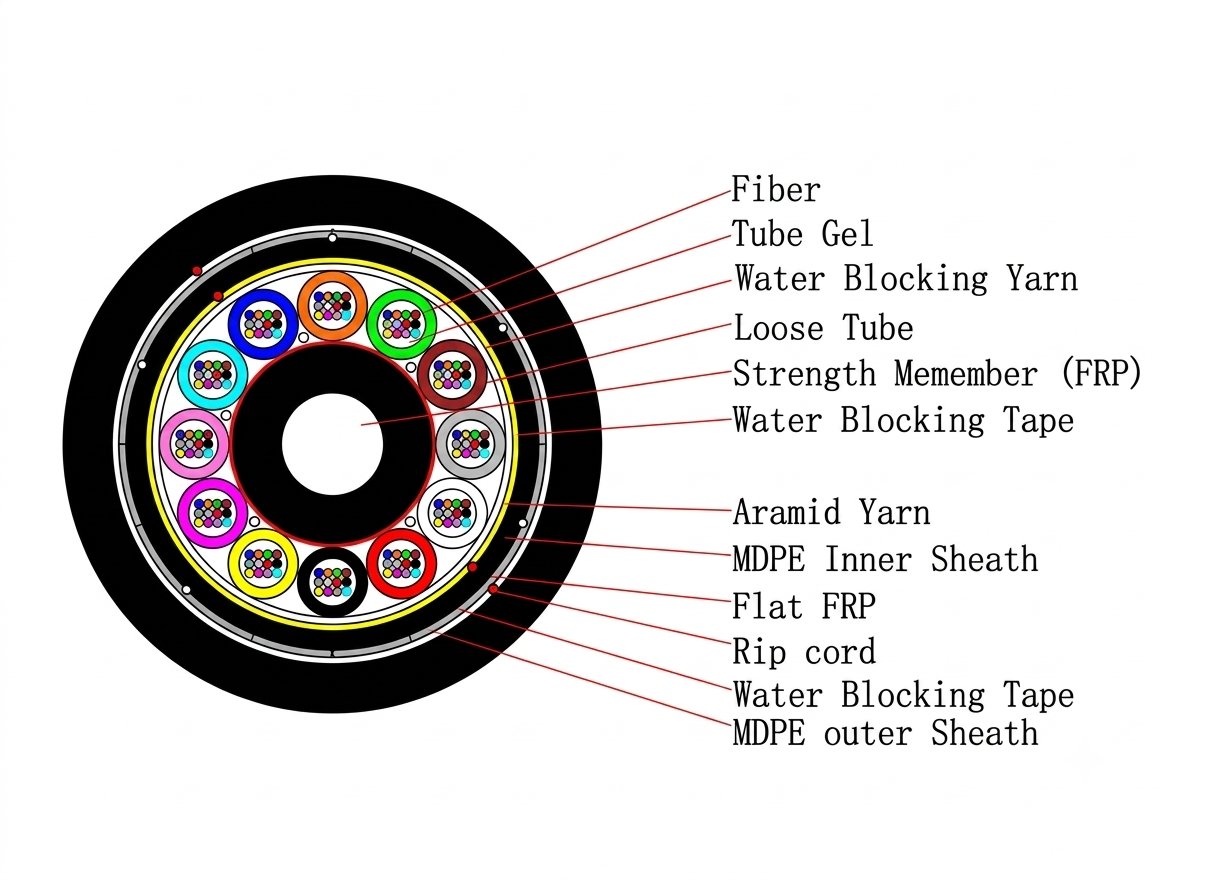
Structure Design:
| Fiber Count |
Number of Tube Positions |
Number of Active Tubes |
Weight |
Nominal Outer Diameter |
Min. Bend Radius (Installation) |
Min. Bend Radius (Operation) |
| 12 – 72 |
6 |
1 – 6 |
138 kg/km
(93lb/1000 ft) |
13.5 mm
(0.53 in) |
203 mm
(8.0 in) |
135 mm
(5.3 in) |
| 192 – 216 |
18 |
16 – 18 |
281 kg/km
(189 lb/1000 ft) |
19.7 mm
(0.78 in) |
296 mm
(11.6 in) |
197 mm
(7.8 in) |
| 288 |
24 |
24 |
421 kg/km
(283 lb/1000 ft) |
23.9 mm
(0.94 in) |
358 mm
(14.1 in) |
239 mm
(9.4 in) |
|
|
|
|
|
|
|
ADSS Fiber Optic Cable FAQs
Q: What type of anti-squirrel/anti-rodent structure does this ADSS cable use?
-
A: Since ADSS cables must remain completely non-metallic, we do not use steel tape armoring. Instead, our cable utilizes a high-strength fiberglass reinforced plastic (FRP) / Glass Yarn layer as a physical barrier. This layer provides extreme hardness that effectively prevents squirrels and rodents from chewing through to the core tubes, while maintaining the cable’s all-dielectric properties.
Q: If chemical repellents are used in the jacket, how long does the anti-rodent effect last?
- A: For regions with heavy rainfall and high humidity (such as Colombia, Ecuador, and parts of Central America), we optimize the formulation to ensure the chemical repellents are deeply integrated into the outer sheath matrix. This prevents them from being easily washed away by rain, ensuring a long-lasting repellent effect typically matching the operational lifespan of the cable.
Q: What jacket material is used, PE or AT?
-
A: It depends on the electric field potential of the space where the cable is installed. For power lines below 110 kV (space potential under 12 kV), a standard Polyethylene (PE) or Tracking-Resistant (TR) jacket is sufficient. For high-voltage lines up to 220 kV (space potential up to 25 kV), a high-grade TRPE (Track-Resistant Polyethylene) jacket is mandatory to prevent dry-band arcing and electrical tracking.
Q: What is the maximum allowable space potential for this cable?
Q: What are the maximum Span and Sag limits for this cable?
-
A: The cross-sectional area of the aramid yarn and glass fiber layers is fully customizable. We can design the cable to accommodate various standard spans (e.g., 50m,100m,200m, or longer) and specific sag requirements based on your local deployment conditions.
Q: Does the cable have UV protection and salinity resistance?
Q: What are the Max Allowed Tension (MAT) and Rated Tensile Strength (RTS)?
Q: Does the cable comply with IEEE and IEC international standards?
- A: Yes, our ADSS cables are fully compliant with IEEE 1222 (for standard testing of ADSS cables) and IEC 60794 series standards.
Q: Do you have vendor approval (Homologación) with local power utilities?
- A: We have extensive experience supplying telecom and power infrastructure projects across LatAm. We can provide standard type test reports and documentation required to secure approval from major local utilities such as CFE (Mexico), EPM/Codensa (Colombia), or Osinergmin (Peru).
Q: What is the standard drum length, and what packaging is used?
- A: Standard drum length is typically 3000m or 4000m to minimize field splice points. The cables are packed in export-grade treated wooden drums or steel-wooden drums designed to withstand long-distance maritime shipping and rugged transport in mountainous terrains.
Q: What is the production lead time?
Engineered for Reliability, Built for Trust
At Telexc, we don’t just supply hardware—we secure your global network deployment. Operating from China’s premier industrial clusters and the Tianjin logistics hub, we act as your private supply chain control tower, ensuring engineering precision and traceably consistent quality for every aerial installation.
Our Core Advantages
- Full-Scenario Aerial Compatibility: We seamlessly bridge the gap between OSP fiber infrastructure, FTTH networks, and aerial deployment scenarios. Every component is structurally engineered to work harmoniously together, drastically increasing on-site installation efficiency.
- Strict Engineering Standard Alignment: Our technical design loops strictly align with international benchmarks, including IEC, ITU-T, and IEEE standards. This ensures our hardware excels under extreme environmental stresses—from intense UV exposure to heavy wind and ice loads.
- Independent Multi-Stage Quality Control: We act as your eyes on the ground. From raw material stress simulations to finished product compliance, our dedicated QC team performs rigorous multi-stage audits so you receive exactly what your engineers approved.
- Optimized Logistics & Flexible Partnerships: Leveraging the logistics power of the Tianjin port, we guarantee reliable transit, competitive factory-direct structures, and transparent milestone tracking to keep your network projects moving forward without compromise.