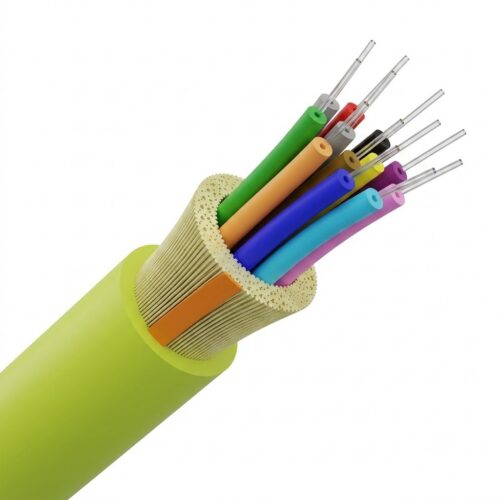
Fiber OSP cable, Single Jacket All-Dielectric, Gel-Free, Stranded Loose Tube, Singlemode G.652.D and G.657.A1

  • All-Dielectric Gel-Free Design: Zero-mess, dry waterblocking eliminates cleanup and slashes installation time.
  • FTTH Optimized: Ideal for outdoor/limited indoor use in lashed aerial and duct installations.
  • Zero Grounding Required: All-dielectric construction eliminates the need for bonding or grounding.
  • Heavy-Duty MDPE Jacket: Rugged, durable, and easy to strip for effortless mid-span access.
  • Extreme Weather Proof: Lightweight with low wind/ice susceptibility; operates from -76°F to +158°F.

https://telexc.com/contact/

Fiber OSP cable, Single Jacket All-Dielectric, Gel-Free, Stranded Loose Tube, Singlemode G.652.D and G.657.A1

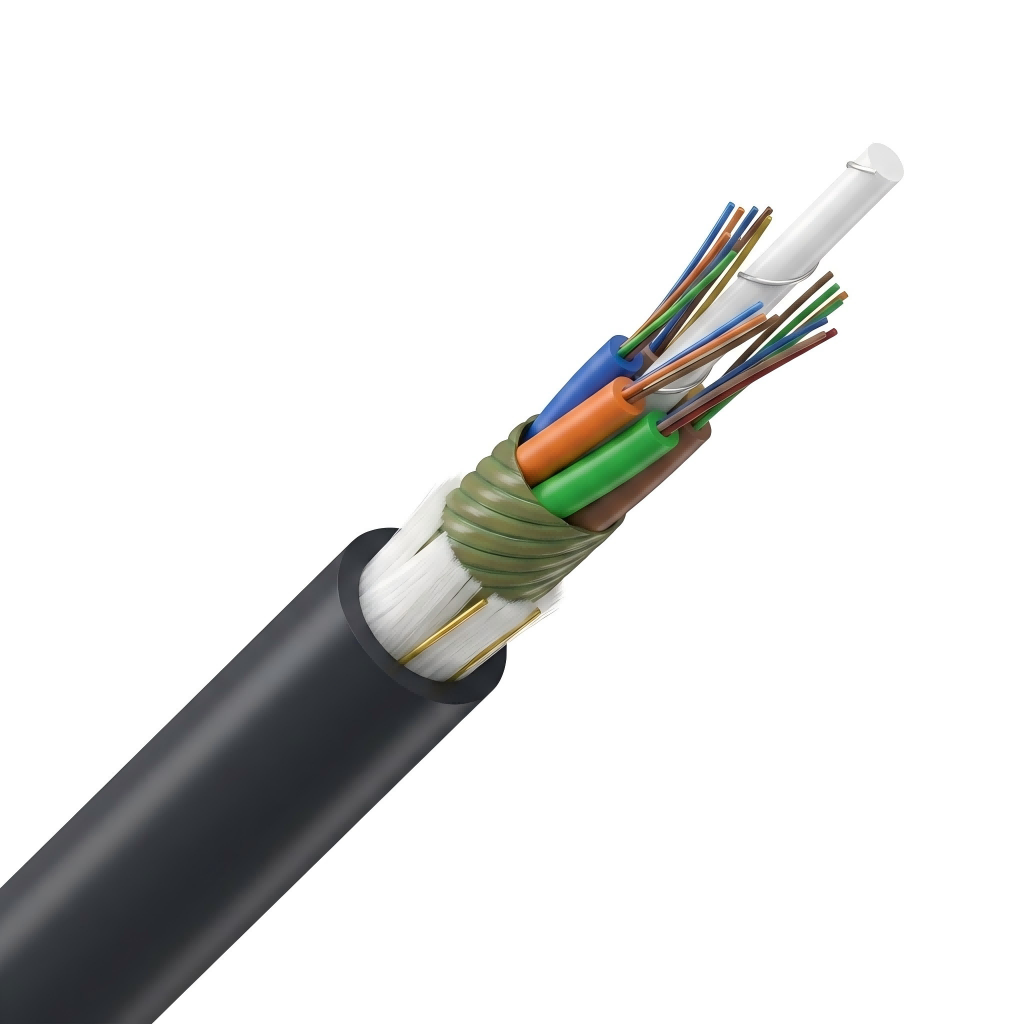
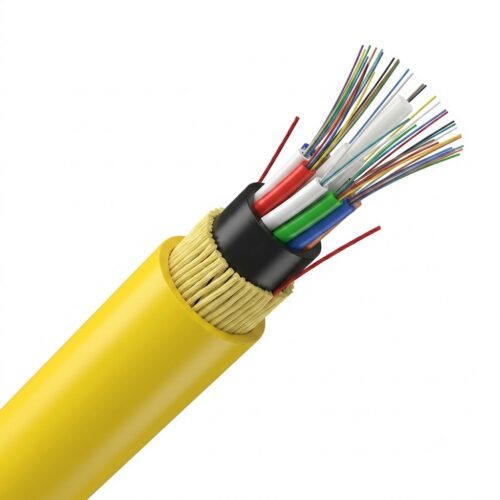
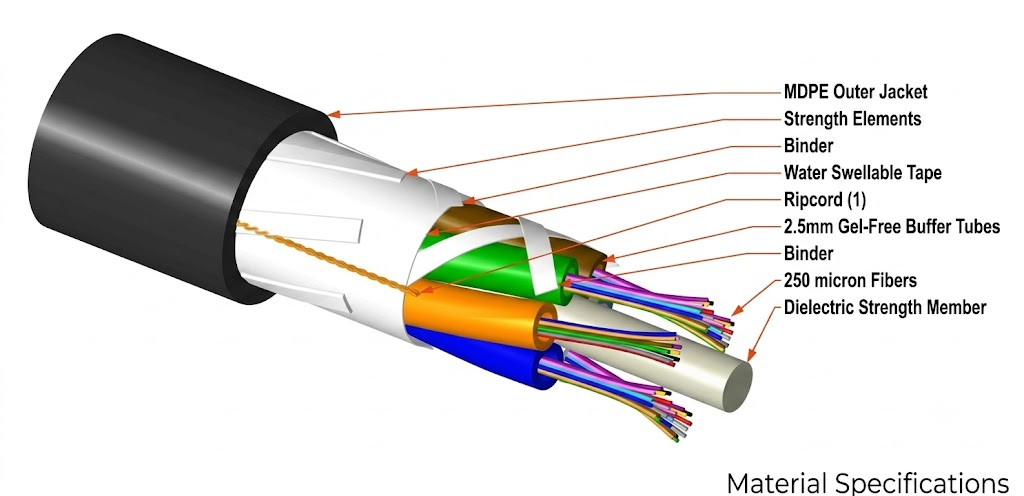
This all-dielectric, gel-free loose-tube optical cable is one of the outside-plant fiber optic cables, typically used for outdoor and limited indoor applications, making it ideal for backbone networks in lashed aerial and duct installations. Its craft-friendly construction utilizes water-swellable materials for comprehensive dry waterblocking, which ensures clean, effortless cable access with zero cleanup required prior to splicing or termination. Featuring an SZ-stranded loose tube design, the cable isolates fibers from installation and environmental stresses while enabling seamless mid-span access, while its flexible buffer tubes allow for easy routing inside closures. Furthermore, the fully dielectric architecture eliminates the need for bonding or grounding, and its rugged medium-density polyethylene (MDPE) outer jacket provides exceptional environmental durability while remaining easy to strip.
 

General Specifications
Product type Fiber OSP cable, Single Jacket All-Dielectric, Gel-Free, Stranded Loose Tube, Singlemode G.652.D and G.657.A1
Jacket Material Medium-density polyethylene (MDPE)
Jacket Marking Feet/Meter
Subunit Type Gel-free
Fiber Coloring Blue, Orange, Green, Brown, Slate, White, Red, Black, Yellow,Violet, Rose, Aqua
Number of Tube Positions 6
Total Fiber Count 2 4 6 12 24 36 48 72 96 144
Number of Active Tubes 1 1 1 1 2 3 4 6 8 12
Number of Filling Elements 4 4 4 4 3 2 1 0 0 0
Number of Tube Positions 5 6 8 12
Fibers per Subunit, quantity 2 4 6 12 12 12 12 12 12 12
 
Dimensions
Buffer Tube/Subunit Diameter  2.5 mm | 0.098 in
Diameter Over Jacket 10.2 mm | 0.402 in 10.5 mm | 0.413 in 14 mm | 0.551 in 15.8 mm | 0.622 in
 
Mechanical Specifications
Minimum Bend Radius, unloaded 102 mm | 4.016 in 105 mm | 4.134 in 140 mm | 5.512 in  158 mm | 6.22 in
Minimum Bend Radius, loaded 204 mm | 8.031 in 210 mm | 8.268 in 280 mm | 11.024 in 316 mm | 12.441 in
Tensile Load, long term, maximum 800 N | 179.847 lbf
Tensile Load, short term, maximum 2700 N | 606.984 lbf
Vertical Rise, maximum 1307 m | 4288.058 ft
Compression 22 N/mm | 125.623 lbf/in
Flex 25 cycles
Impact 4.41 N-m | 39.032 in lb
Twist 10 cycles
 
Optical Specifications, Wavelength Specifications
Fiber Type G.652.D and G.657.A1
Attenuation, maximum 0.3 dB/km @ 1,550 nm | 0.4 dB/km @ 1,310 nm/1383 nm
   
Environmental Specifications
Installation temperature -30 °C to +70 °C (-22 °F to +158 °F)
Operating Temperature -40 °C to +70 °C (-40 °F to +158 °F)
Storage Temperature -40 °C to +75 °C (-40 °F to +167 °F)
Cable Qualification Standards ANSI/ICEA S-87-640 | IEEE-1222
 
Packaging and Weights
Cable weight 65 kg/km | 43.678 lb/kft 67 kg/km | 45.022 lb/kft 107 kg/km | 71.901 lb/kft  165 kg/km | 110.875 lb/kft

FAQs

1. Questions About All-Dielectric & Aerial Design

  • Q: Does an all-dielectric OSP fiber cable require grounding or bonding?

    • A: No, it does not. Because the cable features a completely non-metallic, all-dielectric construction, it is immune to electrical interference and lightning strikes. This eliminates the need for expensive grounding or bonding infrastructure, saving significant installation time and material costs.

  • Q: What is the maximum span distance for a single-jacket ADSS fiber cable?

    • A: The maximum span varies depending on local environmental loads (wind, ice) and sag requirements. Typically, single-jacket ADSS cables are optimized for short-to-medium span applications (ranging from 50m to 150m). For longer spans, the internal aramid yarn and strength elements can be customized to match your specific engineering needs.

  • Q: Can this self-supporting OSP cable withstand heavy wind and ice loads?

    • A: Yes. Designed with a high-strength dielectric member and aramid/glass yarns, this cable maintains low wind and ice susceptibility. It is engineered to withstand extreme weather conditions while keeping cable sag within safe operational limits.

2. Questions About Gel-Free / Dry Waterblocking Technology

  • Q: What are the advantages of gel-free loose tube fiber optic cables?

    • A: Gel-free (completely dry) cables offer a “zero-mess” installation experience. Splicing technicians do not need to use chemical solvents or gels to clean the fibers before splicing, which drastically slashes preparation time, minimizes cleaning consumables, and keeps splicing environments clean.

  • Q: How does a gel-free fiber cable achieve waterblocking without gel?

    • A: Instead of traditional petroleum-based flooding gel, the cable utilizes advanced water-swellable materials (super-absorbent tapes and yarns). Upon contact with any moisture ingress, these dry materials instantly swell to block the penetration and migration of water along the cable core.

3. Questions About Fiber Compatibility (G.652.D & G.657.A1)

  • Q: Can I splice G.652.D fiber with G.657.A1 fiber in FTTH networks?

    • A: Yes, they are 100% backward compatible. Both fibers share the same core/cladding diameter and optical characteristics. Splicing G.652.D with G.657.A1 results in seamless signal transmission with negligible splice loss, making this hybrid configuration ideal for seamless FTTH OSP deployments.

  • Q: What is the benefit of having G.657.A1 fibers in an outdoor OSP cable?

    • A: G.657.A1 is a bend-insensitive single-mode fiber. While G.652.D handles the long-haul backbone transmission efficiently, the G.657.A1 fibers allow the cable to tolerate tighter bends inside closure trays, pedestals, and tight termination boxes without experiencing macrobending attenuation losses.

4. Questions About Jacket Materials & Applications

  • Q: Can MDPE jacket fiber optic cables be installed in both duct and aerial environments?

    • A: Absolutely. Medium-Density Polyethylene (MDPE) provides an ideal balance of robust environmental protection and flexibility. It offers excellent resistance to UV radiation, moisture, and environmental stress cracking, making it perfectly suited for both lashed aerial applications and underground duct pull-throughs.

  • Q: Is an MDPE jacket or an HDPE jacket better for outdoor OSP fiber cables?

    • A: Both offer excellent outdoor protection. However, MDPE is highly preferred by field crews because it is more flexible, has less memory retention during installation, and is significantly easier to strip and access via ripcords compared to stiffer High-Density Polyethylene (HDPE).

5. Questions About Anti-Squirrel / Rodent Protection

  • Q: How do I protect aerial fiber optic cables from squirrel and rodent bites?

    • A: For aerial power utility corridors where metallic armor cannot be used, an Anti-Squirrel All-Dielectric (ADSS) cable is the ideal solution. It integrates high-density, rigid fiberglass yarns or a specialized hard polymer outer jacket that prevents rodents from gnawing through to the internal buffer tubes.

  • Q: Is there a non-metallic anti-rodent fiber cable available for power line deployment?

    • A: Yes. Traditional rodent protection relies on corrugated steel tape, which cannot be installed near high-voltage lines. Our anti-squirrel ADSS cable achieves maximum rodent resistance using non-conductive, high-rigidity dielectric materials, providing complete dielectric safety alongside reliable animal protection.

Engineered for Reliability, Built for Trust

At Telexc, we don’t just supply hardware—we secure your global network deployment. Operating from China’s premier industrial clusters and the Tianjin logistics hub, we act as your private supply chain control tower, ensuring engineering precision and traceably consistent quality for every aerial installation.

Our Core Advantages

  • Full-Scenario Aerial Compatibility: We seamlessly bridge the gap between OSP fiber infrastructure, FTTH networks, and aerial deployment scenarios. Every component is structurally engineered to work harmoniously together, drastically increasing on-site installation efficiency.
  • Strict Engineering Standard Alignment: Our technical design loops strictly align with international benchmarks, including IEC, ITU-T, and IEEE standards. This ensures our hardware excels under extreme environmental stresses—from intense UV exposure to heavy wind and ice loads.
  • Independent Multi-Stage Quality Control: We act as your eyes on the ground. From raw material stress simulations to finished product compliance, our dedicated QC team performs rigorous multi-stage audits so you receive exactly what your engineers approved.
  • Optimized Logistics & Flexible Partnerships: Leveraging the logistics power of the Tianjin port, we guarantee reliable transit, competitive factory-direct structures, and transparent milestone tracking to keep your network projects moving forward without compromise.

Fibre Type Attenuation(+20℃) Bandwidth Numerical Aperture Cable Cut-off Wavelength
  @850nm @1300nm @1310nm @1550nm @850nm @1300nm    
G.652     ≤0.36dB/km <022dB/km       ≤1260nm
G.655     ≤0.40dB/km ≤0.23dB/km       ≤1450nm
50/125μm ≤3.3dB/km ≤1.2dB/km     ≥500MHz.km ≥500MHz ·km 0.200±0.015 NA  
62.5/125μm ≤3.5dB/km ≤1.2dB/km     ≥200MHz ·km ≥500MHz ·km 0.275±0.015NA  
                 

Applications:

  • Rural FTTx Deployment: Leverage existing power poles without new infrastructure — the most cost-effective solution for rural broadband expansion.
  • Medium-Voltage Distribution Lines (≤35kV): Safe co-location on power infrastructure with all-dielectric construction.
  • Telecom Backhaul: Shared utility infrastructure for inter-site connectivity.
  • Campus & Industrial Park Networking: Reliable aerial backbone for enterprise and institutional networks.
  • Not attached to power phase wire or ground wire, can be used for live construction.
  • Suitable for woods and forest routing environments where rodents are serious, especially squirrels.