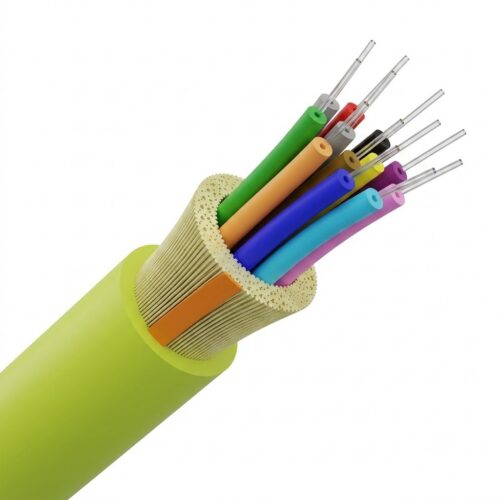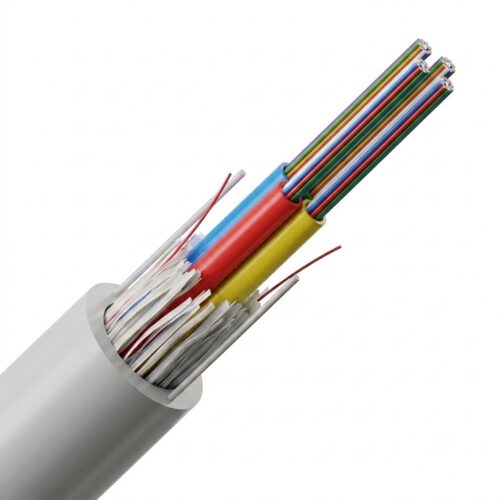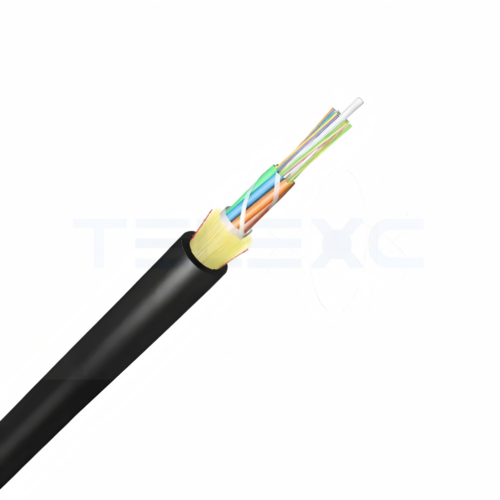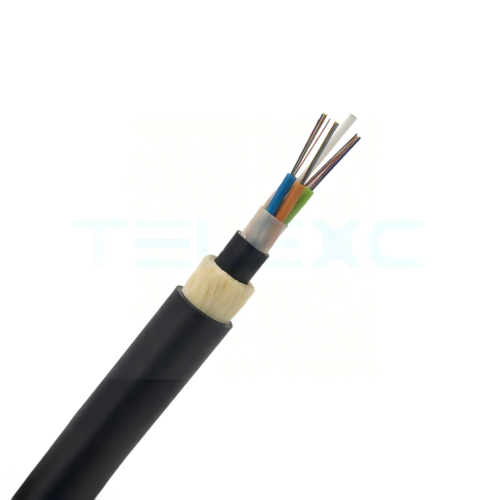
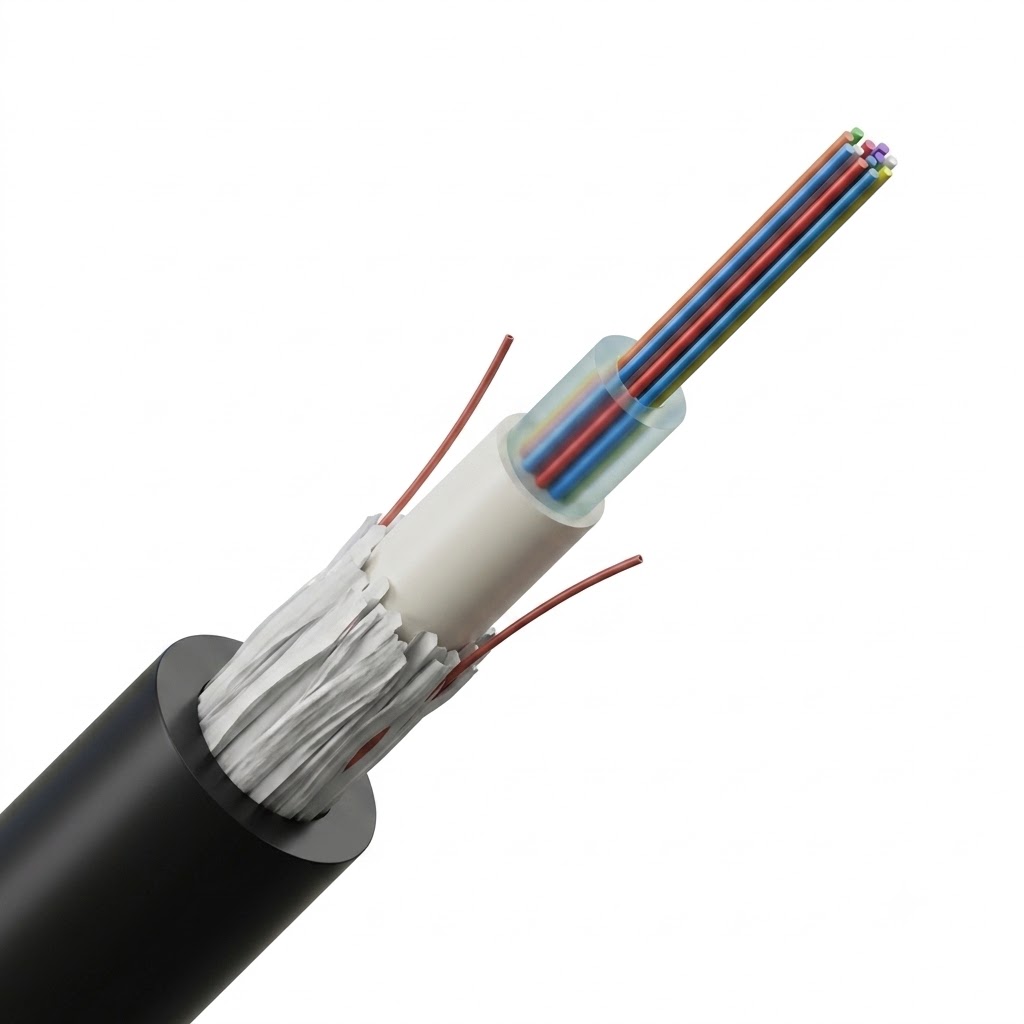
Indoor Central Loose Tube LSOH Fiber Optic Cable

  • Available in 2-24 fiber counts
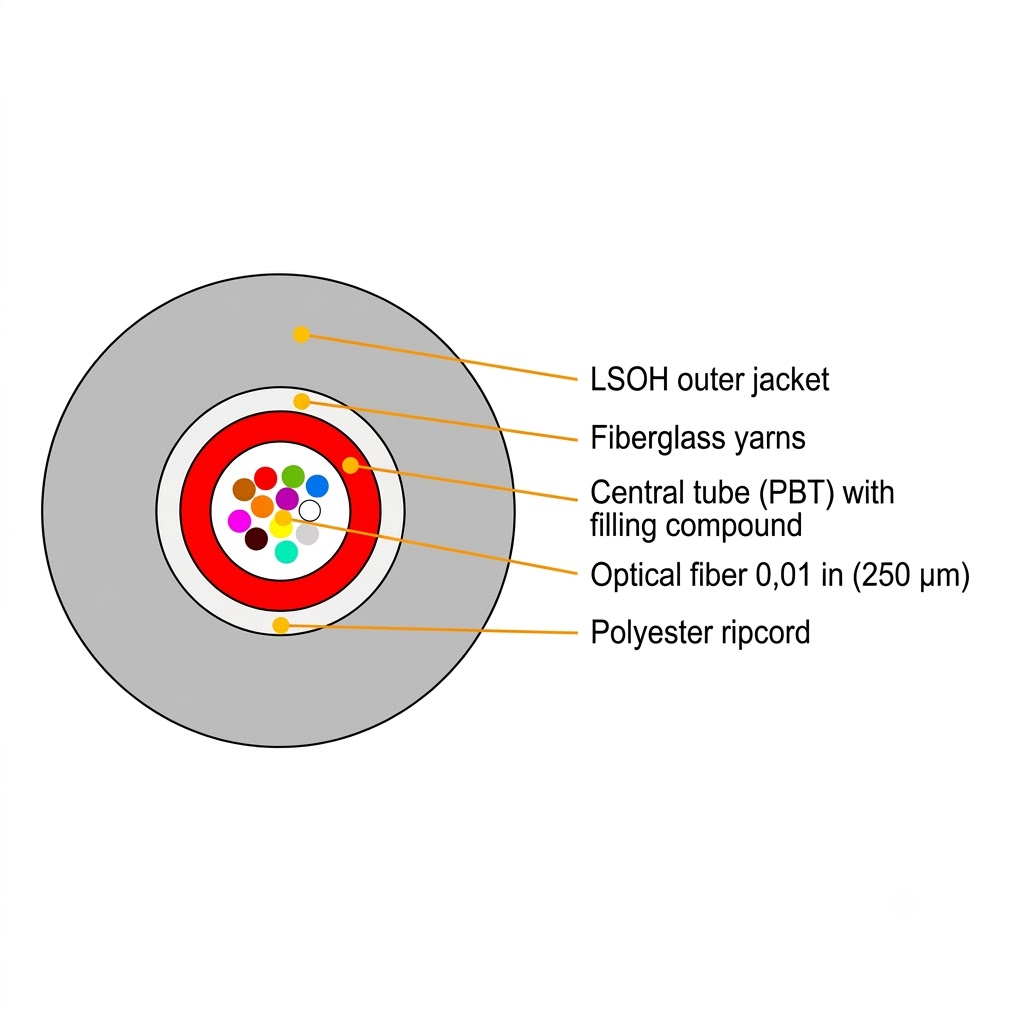
  • Indoor fiber optic cable, Fire-retardant LSOH outer jacket
  • Central tube PBT Ø0,126in (3,2mm) with  filling compound
  • Glass yarn is used as a stress-relief and absorption material
  • Compact structure with excellent flexibility
  • Basic rodent protection
  • Compatible with standard connectors
  • Fully dielectric

https://telexc.com/contact/

Product type Indoor Central Loose Tube LSOH Fiber Optic Cable
Jacket Material LSOH outer jacket
Jacket Marking Feet/Meter
Subunit Type Gel-filled
Fiber Coloring Blue, Orange, Green, Brown, Slate, White, Red, Black, Yellow,Violet, Rose, Aqua
Fiber per tube 2-24
Total Fiber Count 2-6 8-12 16-24
Dimensions
Diameter Over Jacket 6.1mm (0.24 in)
Mechanical Specifications
Minimum Bend Radius, unloaded 91.5 mm (3.602 in)
Minimum Bend Radius, loaded 122.0 mm (4.803 in)
Tensile Load, Installation, maximum 2700 N (607 lbf)
Tensile Load, Operation, maximum 500 N (112 lbf)
Compression 15 N/mm | 86 lb/in
Flex 30 cycles
Impact 2.94 N-m | 26.021 in lb
Twist 10 cycles
Optical Specifications, Wavelength Specifications
Fiber Type G.657A1 and OM4
Attenuation, maximum 0.35 dB/km @ 1310 nm | 0.35 dB/km @ 1383 nm | 0.24 dB/km @ 1490 nm | 0.20 dB/km @ 1550 nm | 0.23 dB/km @ 1625 nm For G.657A1 (Single-Mode Fiber)
2.4 dB/km @ 850 nm | 0.6 dB/km @ 1300 nm For OM4 (Multimode Fiber)
Environmental Specifications
Installation temperature -5 °C to +55 °C (+23 °F to +131 °F)
Operating Temperature -20 °C to +70 °C (-4 °F to +158 °F)
Storage Temperature -20 °C to +70 °C (-4 °F to +158 °F)
Cable Qualification Standards IEC60794-1-21
Packaging and Weights
Cable weight 38kg/km (26lb/kft) 40kg/km (27lb/kft) 42kg/km (28lb/kft)
  • FTTH & FTTx subscriber network connections
  • ODF connections
  • Distribution network
  • Easy indoor deployment, inside house OLT connection

Q1: What is the difference between LSOH and LSZH?

A: There is no functional difference. Both terms—LSOH (Low Smoke Zero Halogen) and LSZH (Low Smoke Zero Halogen)—refer to the exact same jacket material. They are used interchangeably in European, Latin American, and global telecom specs. The material is engineered to produce minimal smoke and release zero toxic halogen gases during combustion (in compliance with IEC 60754-1/2).

Q2: Why choose a Central Loose Tube design for indoor fiber cables?

A: A Central Loose Tube design houses multiple fibers (typically 2 to 24 cores) inside a single protective tube. This offers two key advantages:

Compact & Lightweight: It occupies less space than multi-fiber tight-buffered cables, making it much easier to pull through tight conduits and vertical building shafts.

Mechanical Protection: The central tube insulates the inner fibers from external tensile loads, crushing forces, and severe bending strain.

Q3: What fire safety standards does an indoor LSOH cable meet?

A: LSOH outer jackets comply with international flame-retardant standards such as IEC 60332-1 (single vertical cable test) and IEC 60332-3 (bunched cables test). They are optimized for indoor distribution in data centers, commercial buildings, and public facilities where human safety and corrosion prevention for electronic equipment are critical.

Q4: How is fiber splicing handled for Central Loose Tube cables?

A: During termination at a patch panel or distribution box, the outer jacket and central tube are stripped, and the protective gel is wiped clean. Because the individual fibers inside are standard 250 µm coated fibers, technicians typically use a fan-out kit (furcation kit) to sleeve and protect the bare fibers before fusion splicing or connectorization.

Engineered for Reliability, Built for Trust

At Telexc, we don’t just supply hardware—we secure your global network deployment. Operating from China’s premier industrial clusters and the Tianjin logistics hub, we act as your private supply chain control tower, ensuring engineering precision and traceably consistent quality for every aerial installation.

Our Core Advantages

  • Full-Scenario Aerial Compatibility: We seamlessly bridge the gap between OSP fiber infrastructure, FTTH networks, and aerial deployment scenarios. Every component is structurally engineered to work harmoniously together, drastically increasing on-site installation efficiency.
  • Strict Engineering Standard Alignment: Our technical design loops strictly align with international benchmarks, including IEC, ITU-T, and IEEE standards. This ensures our hardware excels under extreme environmental stresses—from intense UV exposure to heavy wind and ice loads.
  • Independent Multi-Stage Quality Control: We act as your eyes on the ground. From raw material stress simulations to finished product compliance, our dedicated QC team performs rigorous multi-stage audits so you receive exactly what your engineers approved.
  • Optimized Logistics & Flexible Partnerships: Leveraging the logistics power of the Tianjin port, we guarantee reliable transit, competitive factory-direct structures, and transparent milestone tracking to keep your network projects moving forward without compromise.