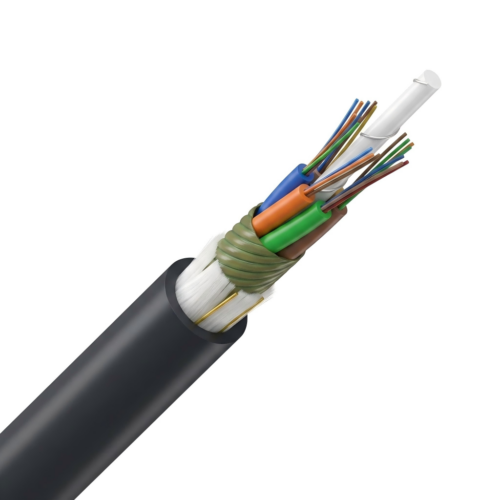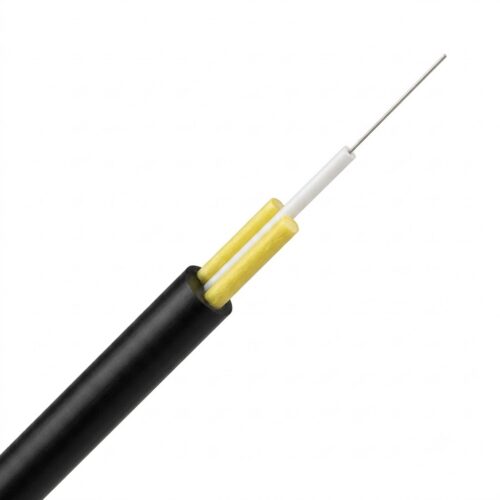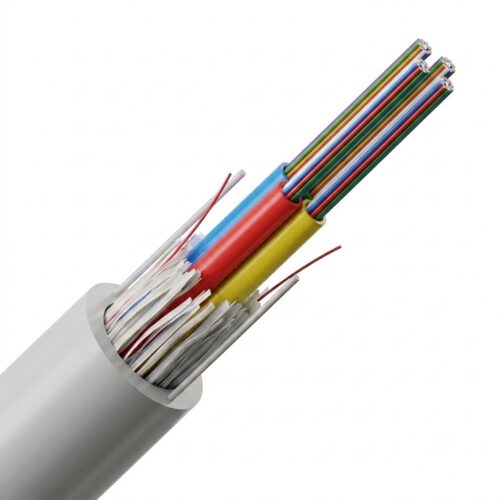
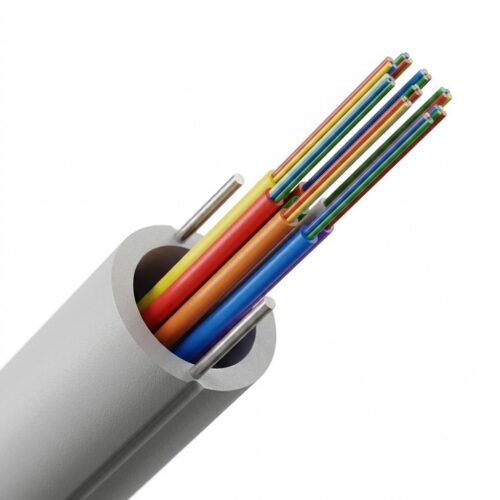
Stranded Loose Tube, Air-blown, microfiber cable

• Available in 12–48 fiber counts with 100% dielectric construction
• Specially formulated low-friction HDPE sheath with air-grooves for optimal jetting efficiency
• Compact outer diameter and lightweight profile for high-density microduct deployment
• Tube-filling compound for superior moisture resistance and fiber protection
• Outstanding blowing performance: Speeds up to 50 m/min, distances up to 1,000 m
• Easy cable removal and replacement for seamless capacity upgrades
• Mid-span branch capability without disruption, minimizing handholes and splices
• Minimizes civil trenching and conduit footprint for cost-effective deployment
• Future-proof solution for high-density FTTH and OSP optical networks

 

General Specifications
Product type Stranded Loose Tube, Air-blown, microfiber cable
Construction Type Non-armored
Fiber Coloring White
Jacket Marking Feet/Meter
Jacket Material High-density polyethylene (HDPE)
Subunit Type Gel-filled
Total Fiber Count 12 | 24 | 48
Dimensions
Buffer Tube/Subunit Diameter 1.45 mm | 0.057 in
Diameter Over Jacket 5.1 mm | 0.201 in
Mechanical Specifications
Max. Tensile Strength, Long-Term 97 N | 21.806 lbf
Max. Tensile Strength, Short-Term 324 N | 72.838 lbf
Minimum Bend Radius, loaded 77 mm | 3.031 in
Minimum Bend Radius, unloaded 51 mm | 2.008 in
Compression 10 N/mm   |   57.101 lb/in
Flex 25 cycles
Impact 0.3 N-m | 2.655 in lb
Twist 10 cycles
Vertical Rise, maximum 492 m | 1,614.173 ft
Optical Specifications
Fiber Type G.652.D and G.657.A1
Attenuation, maximum 0.3 dB/km @ 1,550 nm | 0.4 dB/km @ 1,310 nm/1383 nm
Environmental Specifications
Installation temperature -30 °C to +70 °C (-22 °F to +158 °F)
Operating Temperature -30 °C to +70 °C (-22 °F to +158 °F)
Storage Temperature -30 °C to +75 °C (-22 °F to +167 °F)
Cable Qualification Standards ANSI/ICEA S-87-640 | IEEE-1222
Environmental Test Specifications
Environmental Space Air-blown, microduct
UV Resistance UV stabilized
Temperature Cycle -30 °C to +70 °C (-22 °F to +158 °F)
Cable Freeze -2 °C | 28.4 °F
Drip 70 °C | 158 °F
Heat Age -30 °C to +85 °C (-22 °F to +185 °F)
Low High Bend -30 °C to +60 °C (-22 °F to +140 °F)
Packaging and Weights
Cable weight 22 kg/km | 14.783 lb/kf
  • FTTH Application: The cable can be used as a drop cable for feeder segments in FTTH (Fiber to the Home) networks.
  • Deployment & Function: It is laid using the air-blowing method to connect the branch point with the subscriber access point.

  • Broad Network Compatibility: In addition to FTTH, it is also suitable for backbone networks, metropolitan area networks (MAN), and access networks.

Q1: What is an Air-Blown Microfiber Cable, and how does it differ from traditional outdoor fiber optic cables?

A: An air-blown microfiber cable (such as GCYFY) is specifically engineered with a compact diameter, lightweight structure, and a low-friction outer sheath. Unlike heavy, direct-buried, or standard duct cables, microfiber cables are jetted or blown into microducts using compressed air. This significantly reduces installation time, lowers civil engineering costs, and allows for flexible step-by-step network expansion.

Q2: What cable structures and fiber counts are available for your micro cables?

A: We offer both Central Loose Tube (Uni-tube) for low fiber counts (2–24 cores) and Stranded Loose Tube (SZ stranded) for higher fiber counts (up to 144–288 cores or more). All micro cables utilize G.652.D or bend-insensitive G.657.A1/A2 single-mode optical fibers to ensure low attenuation and optimal bending radii during installation.

Q3: What outer sheath materials are used, and how do they affect blowing distance?

A: Our air-blown cables feature specialized HDPE (High-Density Polyethylene) or low-friction Nylon (PA) outer sheaths. The low-friction coefficient minimizes resistance inside the microduct wall, allowing for smoother, continuous blowing over longer distances (typically up to 1,000–2,000+ meters per pass depending on duct setup and equipment).

Q4: How do I choose the correct outer diameter (OD) for my microduct size?

A: To ensure efficient air-assisted jetting, the cable-to-duct fill ratio (Cable OD / Microduct Inner Diameter) typically needs to be kept between 50% and 70%.

For instance, a 5.0 mm OD micro cable is ideally paired with a 12/9 mm or 10/8 mm microduct.

We can recommend the precise cable outer diameter based on your existing microduct specification.

Q5: Can these microfiber cables withstand harsh outdoor environmental conditions?

A: Yes. Although designed with a slim profile, our stranded loose tube micro cables incorporate water-blocking yarns/tapes, FRP central strength members, and UV-resistant outer jackets. They operate reliably within a temperature range of -40°C to +70°C, making them robust against high-altitude, cold, or high-humidity environments.

Q6: Do you provide OEM/ODM customization and technical support for cable selection?

A: Absolute. We support custom optical fiber types, sheath markings, color coding according to TIA/EIA standards, reel lengths, and packaging tailored for international export. Our engineering team can also review your microduct layout to recommend the most cost-effective cable specifications.

Engineered for Reliability, Built for Trust

At Telexc, we don’t just supply hardware—we secure your global network deployment. Operating from China’s premier industrial clusters and the Tianjin logistics hub, we act as your private supply chain control tower, ensuring engineering precision and traceably consistent quality for every aerial installation.

Our Core Advantages

  • Full-Scenario Aerial Compatibility: We seamlessly bridge the gap between OSP fiber infrastructure, FTTH networks, and aerial deployment scenarios. Every component is structurally engineered to work harmoniously together, drastically increasing on-site installation efficiency.
  • Strict Engineering Standard Alignment: Our technical design loops strictly align with international benchmarks, including IEC, ITU-T, and IEEE standards. This ensures our hardware excels under extreme environmental stresses—from intense UV exposure to heavy wind and ice loads.
  • Independent Multi-Stage Quality Control: We act as your eyes on the ground. From raw material stress simulations to finished product compliance, our dedicated QC team performs rigorous multi-stage audits so you receive exactly what your engineers approved.
  • Optimized Logistics & Flexible Partnerships: Leveraging the logistics power of the Tianjin port, we guarantee reliable transit, competitive factory-direct structures, and transparent milestone tracking to keep your network projects moving forward without compromise.