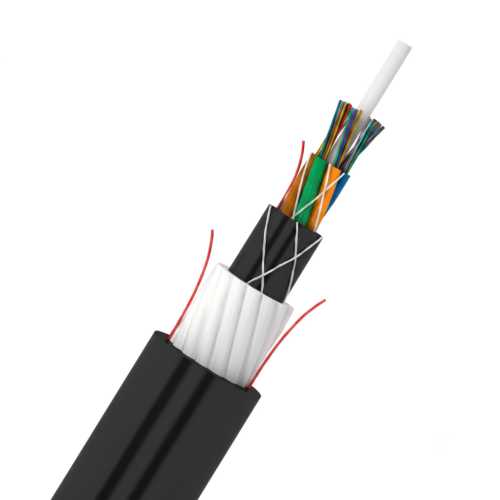
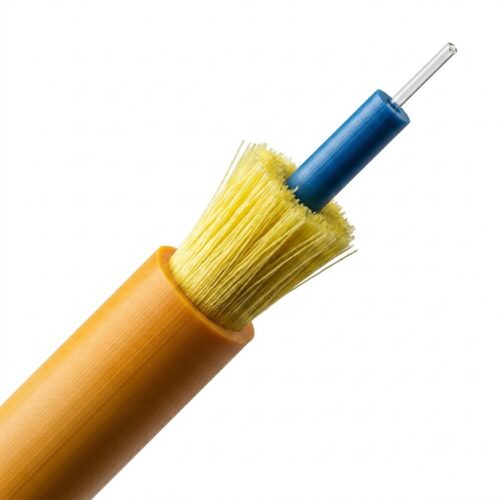
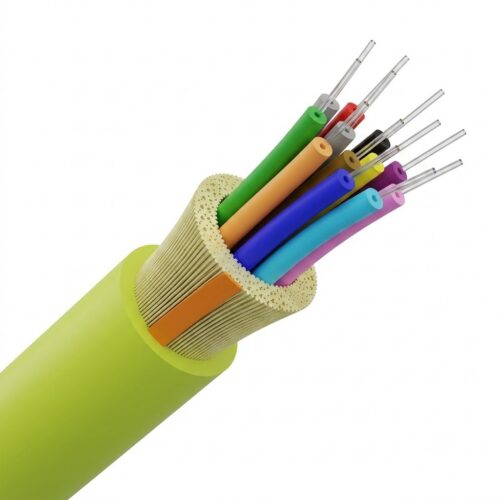
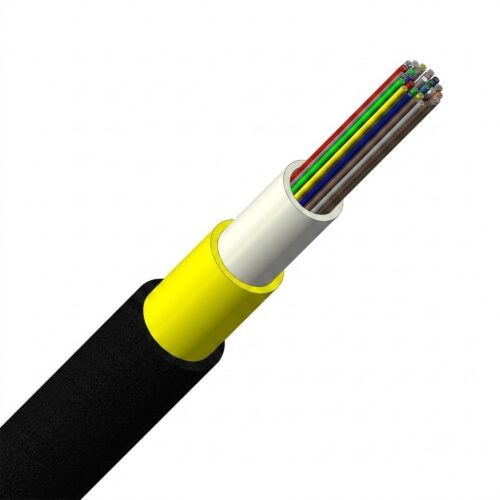
Enhanced Performance Fibre Units Air-Blown Micro Optical Fiber Cable

  • Air-blown micro optical fiber cable  available in 1-12 fiber counts
  • Blowing installation
  • Smallest outer diameter for blowing into 0,197/0,138in (5/3,5mm) duct
  • UV-stabilized polyolefin jacket sheath with low coefficient of friction
  • Water tight central tube with optical fibres
  • Designed with no gel, easy stripping and handling. Outer jacket strip 12-20in (30-50cm)
  • Mechanical fibre fillers can be used
  •  Designed with special grooves to advance blowing distance.
  • Lower Labor and Equipment Costs
  • Longer installation distances ,Smaller Trenching and Conduit Requirements
  • Future-proof scalability

https://telexc.com/contact/


General Specifications
Cable Type Enhanced Performance Fibre Units Air-Blown Micro Optical Fiber Cable
Construction Type Non-armored
Subunit Type  Gel-free
Jacket Material PE (Polyethylene)
Jacket Marking Feet/Meter
Total Fiber Count 1-4 6 8 12
Dimensions
Diameter Over Jacket 1.1 mm (0.043 in) 1.3 mm (0.051 in) 1.4 mm (0.055 in) 1.6 mm (0.063 in)
Mechanical Specifications
Minimum Bend Radius 50 mm (1.969 in) 60 mm (2.362 in) 80 mm (3.150 in) 80 mm (3.150 in)
Tensile Load, long term, maximum 20 N (4 lbf) 25 N (6 lbf) 35 N (8 lbf) 70 N (16 lbf)
Compression 10 N/mm | 57.101 lbf/in
Flex 25 cycles
Impact 2 N-m | 17.701 in lb
Twist 10 cycles
Optical Specifications
Fiber Type  G.652.D and G.657.A1
Attenuation, maximum 0.3 dB/km @ 1,550 nm | 0.4 dB/km @ 1,310 nm/1383 nm
Environmental Specifications
Installation temperature -5 °C to +55 °C (+23 °F to +131 °F)
Operating Temperature -40 °C to +70 °C (-40 °F to +158 °F)
Storage Temperature -40 °C to +70 °C (-40 °F to +158 °F)
Environmental Test Specifications
Environmental Space Air-blown, microduct
Cable Freeze -20 °C to +60 °C (-4 °F to +140 °F)
Blowing Characteristics
Fibre Count 1-4 fibers 6 fibers 8 fibers 12 fibers
Test equipment PLUMETTAZ: UM25, ERICSSON:F, CATWAY:FBT-1.1
Standard duct diameter Out 5.0 / In 3.5 mm | (0.197/0.138 in)
Blowing Pressure 7bar / 10bar
Blowing distance 500m/1000 m 500m/1000 m 500m/1000 m 500m/800m
Blowing time 10min/18min 12min/18min 13min/18min 15min/18min
Packaging and Weights
Cable weight 1.0 kg/km (0.672 lb/kft) 1.2 kg/km (0.806 lb/kft) 1.6 kg/km (1.075 lb/kft) 1.6 kg/km (1.075 lb/kft)
  • Outdoor installation

  • Distribution Networks

  • Microduct installation

  • FTTH & last mile connection

  • 5G Backhaul and Fronthaul

  • Data Center Interconnects

  • Rural Broadband

  • Smart City and IoT Networks

Q1: What is a Central Loose Tube Fiber Optic Cable?

A: A central loose tube cable features a single, central protective plastic tube housing all optical fibers (typically 2 to 24 fibers). The fibers float inside the tube, which is filled with a water-blocking gel or dry water-swellable materials. Structural reinforcement is provided by parallel strength members (such as dual FRP rods or steel wires) placed symmetrically on both sides of the central tube under an outer HDPE/LSZH jacket.


Q2: Central Loose Tube vs. Stranded Loose Tube: What are the main differences?

Feature Central Loose Tube Cable Stranded Loose Tube Cable
Structure Single central tube containing all fibers Multiple loose tubes stranded around a Central Strength Member (CSM)
Fiber Count Low to medium capacity (typically 2 to 24 fibers) High capacity (24 to 288+ fibers)
Cable Diameter & Weight Smaller outer diameter, lightweight Larger outer diameter, heavier weight
Installation & Cost Cost-effective, faster stripping, compact splice trays Higher material & labor cost, flexible breakout per tube

Q3: What are the key advantages of Central Loose Tube Cables?

  • Compact & Lightweight Structure: Saves space in micro-ducts, conduits, and cable trays, making it ideal for high-density routes.

  • Cost Efficiency: Simplifies manufacturing and reduces installation/splicing time, leading to significant material and labor savings.

  • Balanced Mechanical Protection: Dual parallel strength members ensure stable tensile strength while protecting the fibers from axial load stress.


Q4: Are Central Loose Tube Cables suitable for FTTH and Air-Blowing Micro Duct deployments?

Yes. Central loose tube micro cables are widely used in FTTH last-mile access and micro duct networks. Their slim profile (3–6 mm outer diameter) and low friction outer jackets allow long-distance pneumatic air blowing (1,000–2,500 meters) into micro ducts with minimal tension.


Q5: What mechanical and environmental protection options are available?

  • Waterproofing: Available in gel-filled or gel-free (dry tube) designs using water-blocking yarn/tape for faster, cleaner splicing.

  • Armored & Anti-Rodent Protection:

    • Corrugated Steel Tape (PSP): Provides crush resistance and rodent protection for direct-buried or underground duct applications (e.g., GYXTW).

    • Non-Metallic Protection: Uses glass yarn, aramid yarn, or FRP rods for all-dielectric, lightning-proof installations.


Q6: How do I choose the right Central Loose Tube specification for my project?

  1. Deployment Method:

    • Air Blowing Micro Duct: Select a non-metallic, lightweight, and low-friction micro cable.

    • Duct / Direct Buried / High Rodent Risk: Choose a corrugated steel tape armored cable (e.g., GYXTW).

    • Aerial (Self-Supporting / Messenger): Select a Figure-8 or FRP-reinforced aerial central tube cable.

  2. Fiber Selection: Standard Single-Mode (G.652D) or Bend-Insensitive Single-Mode (G.657A1/A2) for tight bend radiuses in distribution boxes.

Engineered for Reliability, Built for Trust

At Telexc, we don’t just supply hardware—we secure your global network deployment. Operating from China’s premier industrial clusters and the Tianjin logistics hub, we act as your private supply chain control tower, ensuring engineering precision and traceably consistent quality for every aerial installation.

Our Core Advantages

  • Full-Scenario Aerial Compatibility: We seamlessly bridge the gap between OSP fiber infrastructure, FTTH networks, and aerial deployment scenarios. Every component is structurally engineered to work harmoniously together, drastically increasing on-site installation efficiency.
  • Strict Engineering Standard Alignment: Our technical design loops strictly align with international benchmarks, including IEC, ITU-T, and IEEE standards. This ensures our hardware excels under extreme environmental stresses—from intense UV exposure to heavy wind and ice loads.
  • Independent Multi-Stage Quality Control: We act as your eyes on the ground. From raw material stress simulations to finished product compliance, our dedicated QC team performs rigorous multi-stage audits so you receive exactly what your engineers approved.
  • Optimized Logistics & Flexible Partnerships: Leveraging the logistics power of the Tianjin port, we guarantee reliable transit, competitive factory-direct structures, and transparent milestone tracking to keep your network projects moving forward without compromise.