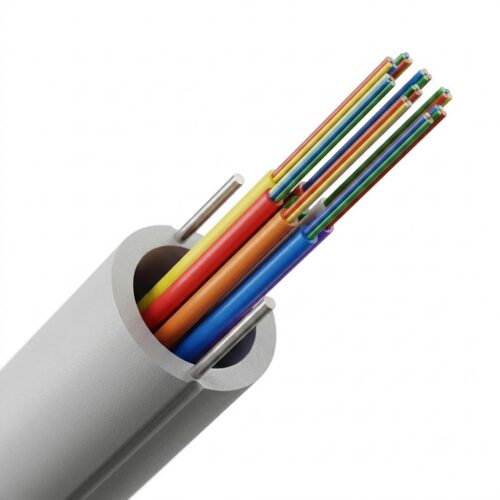
Direct Buried Armored Optical Cable (Single jacket cable with central tube)

Direct Buried Armored Optical Cable (Single jacket cable with central tube)

  • Features corrugated steel tape armor and a single PE sheath to resist rodents and crushing in direct burial OSP environments.
  • Available from 2 to 24 fibers for seamless network expansion.


  • Supports G.652D, G.657A, and G.655C single-mode fibers to meet diverse bend-insensitivity demands.


  • Ensures ultra-low attenuation characteristics (≤0.36 dB/km at 1310 nm; ≤0.22 dB/km at 1550 nm) for long-distance transmission.


  • Provides versatile deployment options for direct burial, duct, conduit, and aerial installations.


  • Central loose tube 0,118in (3,0 mm) with filing compound


  • Delivers a future-proof, robust infrastructure solution for FTTH and outdoor fiber optic networks.
  • For installation into existing duct or directly buried Rodent retardant

 

Direct Buried Armored Optical Cable (Single jacket cable with central tube)

Product type Central tube, Direct Buried Armored Optical Cable
Construction Type Armored
Fiber Coloring White
Feet/Meter
Jacket Material PE (Polyethylene)
Subunit Type Gel-filled
Total Fiber Count 2-24
Dimensions
Buffer Tube/Subunit Diameter 3 mm | 0.118 in
Diameter Over Jacket 7.6 mm | 0.299 in
Mechanical Specifications
Tensile Load, Installation, maximum 1800 N (405 lbf)
Tensile Load, Operation, maximum 900 N (202 lbf)
Minimum Bend Radius, loaded 152 mm | 5.984 in
Minimum Bend Radius, unloaded 92mm | 3.622 in
Compression 30 N/mm | 171.304 lb/in
Flex 25 cycles
Impact 5 N-m | 44.254 in lb
Twist 5 cycles
Optical Specifications
Fiber Type G.652.D and G.657.A1
Attenuation, maximum 0.3 dB/km @ 1,550 nm | 0.4 dB/km @ 1,310 nm/1383 nm
Environmental Specifications
Installation temperature -20 °C to +70 °C (-4 °F to +158 °F)
Operating Temperature -20 °C to +70 °C (-4 °F to +158 °F)
Storage Temperature -20 °C to +70 °C (-4 °F to +158 °F)
Cable Qualification Standards ANSI/ICEA S-87-640 | IEEE-1222
Water Penetration Sample length: 3m | Water head: 1m | Time: 24h
No leakage
Water Test: IEC 60794-1-22 Method F5
Environmental Test Specifications
Environmental Space Direct buried | Duct installation | Outdoor
UV Resistance UV stabilized
Temperature Cycle -20 °C to +60 °C (-4 °F to +140 °F)
Packaging and Weights
Cable weight 69kg/km | 46 lb/kft
1. Long-Haul Trunk Networks & Backbone Lines

Characteristics: Used to connect high-capacity communication backbones across cities, regions, or international borders.

Key Advantages: Direct trenching is more cost-effective than long-distance aerial pole lines across plains, hills, or mountains. It offers extreme reliability by being immune to severe weather conditions like typhoons and icing.

2. Rural & Suburban Network Expansion

Characteristics: Extends high-speed fiber networks from urban backbones to remote villages, new industrial zones, or development parks.

Key Advantages: In areas lacking underground conduit (duct) infrastructure and where installing poles is impractical, direct burial is the most economical and fast way to achieve broadband coverage.

3. Transportation Corridors (Highways & Railways)

Characteristics: Deployed along green belts or roadbeds parallel to highways, national roads, railways, or urban transit lines.

Key Advantages: Leverages existing transportation rights-of-way for easier construction and maintenance. The armored structure withstands heavy traffic vibrations and ground pressure.

4. Energy & Industrial Infrastructure

Oil & Gas Pipelines: Buried in the same trench or parallel to pipelines for real-time monitoring data transmission and dispatch communications.

Wind & Solar Farms: Interconnects individual turbines/solar arrays with booster stations and control centers, withstanding harsh freeze-thaw cycles, extreme sun exposure, and heavy construction equipment loads.

Mining & Industrial Plants: Secure communication links across plant perimeters or complex mining terrains.

5. Extreme Environments & Harsh Terrains

Cold & High-Altitude Regions: Prevents icing and breakage common in aerial lines; burying below the frost line ensures year-round stability.

Rodent & Termite Heavy Areas: Uses Corrugated Steel Tape Armor (CSTA) or Steel Wire Armor (SWA) to prevent rodents and insects from biting through the outer jacket.

Q1: How deep should underground fiber optic cables be buried?

A: Underground fiber cables are typically buried at a depth of 18 to 36 inches, depending on local regulations, soil composition, and specific site conditions.

  • Urban Areas: Typically 12–24 inches.

  • Rural or High-Traffic Zones: Often requires 24–48 inches for enhanced mechanical protection.

Note: Always comply with local municipal codes and industry standards prior to installation to minimize the risk of external damage and ensure long-term operational safety.

Q2: Which fiber types are best for underground installation?

A: The most suitable cables for underground deployments are loose tube cables and armored fiber cables:

  • Loose Tube Fiber Cable: Offers exceptional resistance to moisture and environmental fluctuations, making it ideal for conduit/duct installations.

  • Armored Fiber Cable: Features a protective metallic layer that shields against rock pressure, rodents, and construction stress, making it the top choice for direct burial or harsh environments.

Selection Tip: Evaluate your conduit usage, soil conditions, and external risk factors to choose the optimal cable for long-term durability.

Q3: How long does an underground fiber installation take?

A: Project timelines vary based on scope, terrain, installation complexity, and permitting requirements.

  • Small Projects: Residential or small commercial jobs typically take a few days.

  • Large Projects: Municipal, campus, or industrial deployments can take several weeks to months.

Factors to Consider: Roadwork, multi-party coordination, and municipal permitting significantly impact schedules. Early, careful planning is essential for on-time project completion.

Q4: Does underground fiber cable require maintenance?

A: Yes. Although underground cables are protected from many overhead environmental hazards, routine inspections and preventive maintenance are vital for long-term network reliability. Standard maintenance practices include:

  • Visual inspections

  • Optical performance testing

  • Path monitoring to detect signal degradation or environmental risks early

Proactive maintenance helps minimize unexpected outages and ensures peak network efficiency over time.

Engineered for Reliability, Built for Trust

At Telexc, we don’t just supply hardware—we secure your global network deployment. Operating from China’s premier industrial clusters and the Tianjin logistics hub, we act as your private supply chain control tower, ensuring engineering precision and traceably consistent quality for every aerial installation.

Our Core Advantages

  • Full-Scenario Aerial Compatibility: We seamlessly bridge the gap between OSP fiber infrastructure, FTTH networks, and aerial deployment scenarios. Every component is structurally engineered to work harmoniously together, drastically increasing on-site installation efficiency.
  • Strict Engineering Standard Alignment: Our technical design loops strictly align with international benchmarks, including IEC, ITU-T, and IEEE standards. This ensures our hardware excels under extreme environmental stresses—from intense UV exposure to heavy wind and ice loads.
  • Independent Multi-Stage Quality Control: We act as your eyes on the ground. From raw material stress simulations to finished product compliance, our dedicated QC team performs rigorous multi-stage audits so you receive exactly what your engineers approved.
  • Optimized Logistics & Flexible Partnerships: Leveraging the logistics power of the Tianjin port, we guarantee reliable transit, competitive factory-direct structures, and transparent milestone tracking to keep your network projects moving forward without compromise.