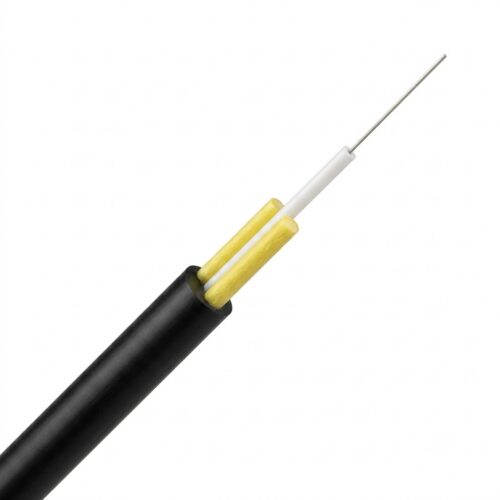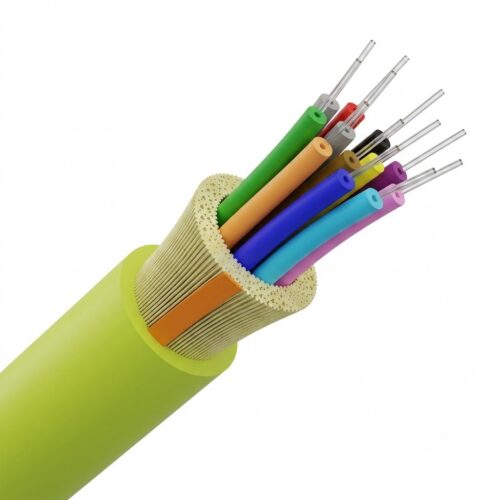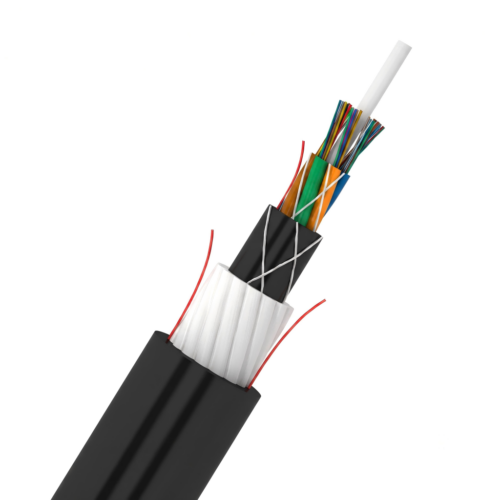
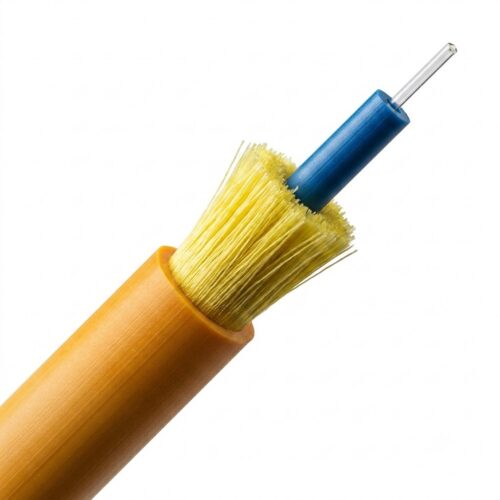
Fan-out Tactical Cable

Fan-out Tactical Cable
  • Cut-resistant, fire-retardant, LSZH polyurethane jacket
  • Highly flexible construction allows for multiple deployments
  • All aramid-strength members
  • Performance in a wide temperature range,can maintain softness in low temperature.
  • UV, fungus, and water resistant
  • High impact and crush resistance
  • Durable in high-traffic areas
  • Supports G.652D, G.657A, and G.655C single-mode fibers to meet diverse bend-insensitivity demands.
  • Ensures ultra-low attenuation characteristics (≤0.36 dB/km at 1310 nm; ≤0.23 dB/km at 1550 nm) for long-distance transmission.
  • Provides field deployment options for high-traffic areas, Security and Sensing, and broadcast deployments.

https://telexc.com/contact/


Fan-out Tactical Cable
General Specifications
Cable Type Fan-out Tactical Cable
Subunit Type Gel-free
Jacket Material TPU(Thermoplastic Polyurethane)
Jacket Marking Feet/Meter
Total Fiber Count 2 4 6 8 12
Dimensions
Diameter Over Jacket 7.0 mm (0.276 in) 7.0 mm (0.276 in) 8.5 mm (0.335 in) 10.0 mm (0.394 in) 12.5 mm (0.492 in)
Mechanical Specifications
Minimum Bend Radius, loaded 140.0 mm (5.5 in) 140.0 mm (5.5 in) 170.0 mm (6.7 in) 200.0 mm (7.9 in) 250.0 mm (9.8 in)
Minimum Bend Radius, unloaded 70.0 mm (2.8 in) 70.0 mm (2.8 in) 85.0 mm (3.3 in) 100.0 mm (3.9 in) 125.0 mm (4.9 in)
Tensile Load, Installation, maximum 800 N (180 lbf )
Tensile Load, Operation, maximum 400 N (90 lbf)
Compression 3 N/mm | 67 lbf / 3.937 in
Flex 25 cycles
Impact 4.5 N-m | 40 in-lb
Twist 10 cycles
Optical Specifications
Fiber Type  G.652.D and G.657.A1
Attenuation, maximum 0.3 dB/km @ 1,550 nm | 0.4 dB/km @ 1,310 nm/1383 nm
Environmental Specifications
Installation temperature -30 °C to 70 °C (-22 °F to 158 °F )
Operating Temperature -40 °C to 70 °C (-40 °F to 158 °F )
Storage Temperature -40 °C to 70 °C (-40 °F to 158 °F )
Water Penetration Sample length: 3m | Water head: 1m | Time: 24h
No leakage
Water Test: IEC 60794-1-22 Method F5
Environmental Test Specifications
Environmental Space Duct installation | Outdoor
Packaging and Weights
Cable weight 60 kg/km (40.318 lb/kft) 60 kg/km (40.318 lb/kft) 70 kg/km (47.038 lb/kft) 90 kg/km (60.477 lb/kft) 130 kg/km (87.356 lb/kft)
  • Military Ground Systems: Heavy-duty dielectric tactical assemblies with MIL-DTL-83526 plugs. Deploys EMI-proof links across forward command posts, radio towers, and mobile radar stations. Tactical links connect ground sensors in remote borders.

  • Outside Broadcasting Networks: Lightweight pre-spooled tactical lines with LC, SC, or TFOCA plugs. Transmits uncompressed 4K and 8K video streams from stadium sidelines to broadcast trucks.

  • Disaster Recovery Systems: Fast-deployment spooled cable assemblies with genderless plugs. Builds temporary communication links where natural disasters destroy fixed grid lines.

  • Industrial and Mining Plants: Chemical-resistant TPU-jacketed cables with optional steel armor. Links remote monitoring sensors, automated mining drills, and safety systems across open-pit mines and oil rigs.

1. What is a Tactical Fiber Optic Cable, and how does it differ from standard outdoor fiber cables?

  • Fact-Based Answer:

    A tactical fiber optic cable is a heavy-duty, highly flexible field cable designed specifically for rapid deployment, frequent retrieval, and harsh environments.

    • Key Differences: Unlike standard outdoor cables (which are rigid, optimized for permanent underground or aerial installation, and require fusion splicing), tactical cables feature a tight-buffered fiber design with high-tensile aramid/Kevlar strength members and a abrasion-resistant Polyurethane (PUR/PU) jacket. This construction allows them to be repeatedly rolled out and re-reeled without compromising optical performance.

2. How crush-resistant and durable are tactical fiber cables? Can they withstand vehicle runovers?

  • Fact-Based Answer:

    Yes. Extreme crush and impact resistance are primary design requirements for tactical fiber.

    • Mechanical Specs: High-quality military-grade tactical cables typically handle a crush load of 2,000 N/cm or higher. They are built to survive heavy foot traffic, tank and armored vehicle runovers, sharp rock impacts, and extreme temperatures without damaging the internal glass fibers.

    • Rodent & Cut Resistance: Premium versions incorporate flexible stainless-steel armor under the jacket to prevent rodent damage and sharp cuts.

3. What are the main applications for tactical fiber optic cables?

  • Fact-Based Answer:

    While initially developed for defense, tactical cables are widely used wherever temporary, high-bandwidth communications are needed:

    • Military & Defense: Tactical Operation Centers (TOC), field radar, mobile communication nodes, and ground-control systems for UAVs.

    • Broadcast & Live Events: Outdoor Broadcasting (OB) vans, 4K/8K video transmission at concerts, stadiums, and news sites.

    • Emergency & Disaster Recovery: Temporary network restoration during natural disasters.

    • Industrial & Mining: Moving machinery and mobile site setups in oil, gas, and mining environments.

4. What connectors are commonly used with tactical fiber cables?

  • Fact-Based Answer:

    Because standard connectors (like LC or SC) are too fragile for dusty and wet field conditions, tactical cable assemblies usually rely on ruggedized connectors:

    • Expanded Beam Connectors: Utilize lenses to expand the light beam across the connection interface. This makes them highly resistant to dirt, dust, and water contamination and very easy to clean in the field.

    • TFOCA / MIL-DTL-83526: Hermaphroditic (genderless) military-standard connectors featuring metal protective housings, sealing gaskets, and dust caps.

    • IP-Rated Industrial Connectors: IP67/IP68-rated LC/MPO housings often used in commercial and broadcast environments.

5. How should tactical fiber optic cables be deployed and maintained?

  • Fact-Based Answer:

    • Deployment: Cables are usually pre-assembled on heavy-duty deployment reels equipped with hand cranks, drag brakes, and storage drums for connector tails. They can be deployed manually on foot or behind vehicles.

    • Maintenance: Before re-reeling, visually inspect the outer jacket for severe cuts or kinks. Connectors should be protected with dust caps when not in use. Expanded beam connectors can be cleaned in the field using isopropyl alcohol (IPA) or rinsed with water if heavily soiled with mud.

Engineered for Reliability, Built for Trust

At Telexc, we don’t just supply hardware—we secure your global network deployment. Operating from China’s premier industrial clusters and the Tianjin logistics hub, we act as your private supply chain control tower, ensuring engineering precision and traceably consistent quality for every aerial installation.

Our Core Advantages

  • Full-Scenario Aerial Compatibility: We seamlessly bridge the gap between OSP fiber infrastructure, FTTH networks, and aerial deployment scenarios. Every component is structurally engineered to work harmoniously together, drastically increasing on-site installation efficiency.
  • Strict Engineering Standard Alignment: Our technical design loops strictly align with international benchmarks, including IEC, ITU-T, and IEEE standards. This ensures our hardware excels under extreme environmental stresses—from intense UV exposure to heavy wind and ice loads.
  • Independent Multi-Stage Quality Control: We act as your eyes on the ground. From raw material stress simulations to finished product compliance, our dedicated QC team performs rigorous multi-stage audits so you receive exactly what your engineers approved.
  • Optimized Logistics & Flexible Partnerships: Leveraging the logistics power of the Tianjin port, we guarantee reliable transit, competitive factory-direct structures, and transparent milestone tracking to keep your network projects moving forward without compromise.