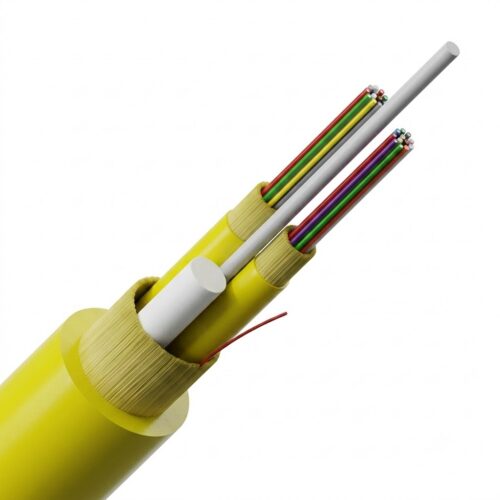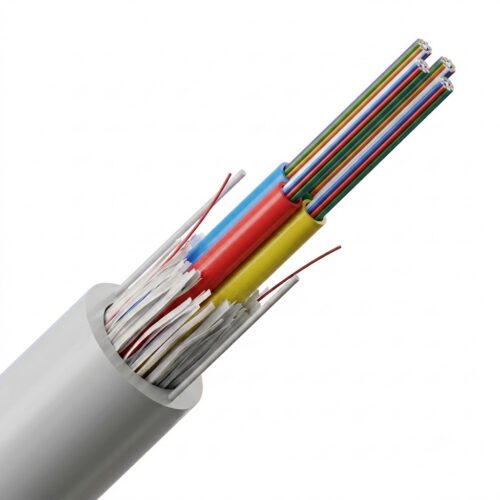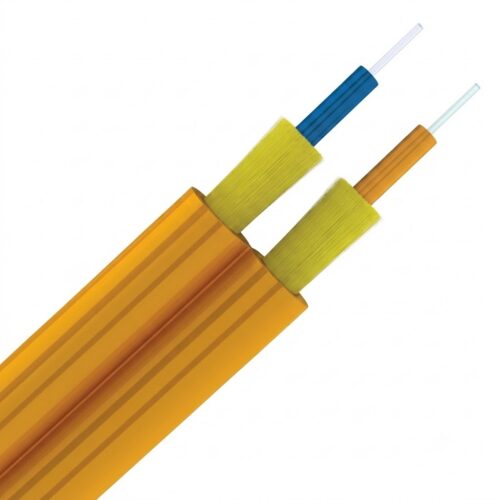
Stranded Loose Tube Optical Fiber Ribbon Cable

  • Mass fusion splicing for rapid deployment and time savings
  • Armored with anti-moisture steel tape
  • Gelly-filled, PBT loose tubes with optical fibers
  • Higher fiber density, available from 144 to 864 fibers for seamless network expansion.
  • Supports G.652D, G.657A, and G.655C single-mode fibers to meet diverse bend-insensitivity demands.
  • Ensures ultra-low attenuation characteristics (≤0.36 dB/km at 1310 nm; ≤0.23 dB/km at 1550 nm) for long-distance transmission.
  • Provides versatile deployment options for duct, conduit, and aerial installations.
  • Delivers a future-proof, robust infrastructure solution for FTTH and outdoor fiber optic networks.

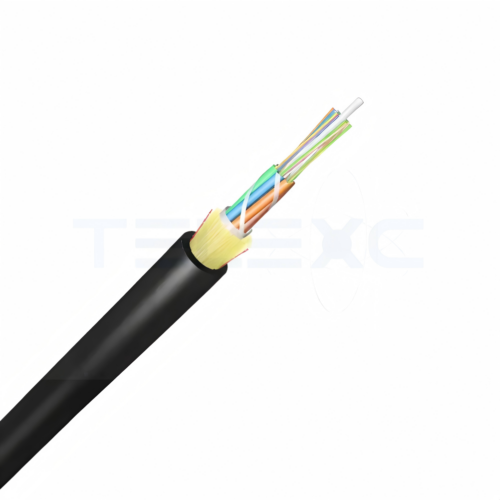
 

Stranded Loose Tube Optical Fiber Ribbon Cable 
General Specifications
Cable Type Stranded Loose Tube Optical Fiber Ribbon Cable 
Construction Type Armored
Subunit Type Gel-filled
Jacket Material PE (Polyethylene)
Jacket Marking Feet/Meter
Total Fiber Count 144 192 216 288 432 576
Dimensions
Diameter Over Jacket 16.8 mm (0.661 in) 17.4 mm (0.685 in) 19.6 mm (0.772 in) 18.5 mm (0.728 in) 21.7 mm (0.854 in) 22.3 mm (0.878 in)
Mechanical Specifications
Minimum Bend Radius, loaded 336 mm (13.2 in) 348 mm (13.7 in) 392 mm (15.4 in) 370 mm (14.5 in) 434 mm (17.1 in) 446 mm (17.5 in)
Minimum Bend Radius, unloaded 168 mm
(6.6 in)
174 mm
(6.8 in)
196 mm
(7.7 in)
185 mm
(7.2 in)
217 mm
(8.5 in)
223 mm
(8.7 in)
Tensile Load, Installation, maximum 1000 N (225 lbf)
Tensile Load, Operation, maximum 300 N (67 lbf)
Compression 3 N/mm | 67 lbf / 3.937 in
Flex 25 cycles
Impact 4.5 N-m | 40 in-lb
Twist 10 cycles
Optical Specifications
Fiber Type  G.652.D and G.657.A1
Attenuation, maximum 0.3 dB/km @ 1,550 nm | 0.4 dB/km @ 1,310 nm/1383 nm
Environmental Specifications
Installation temperature -30 °C to 70 °C (-22 °F to 158 °F )
Operating Temperature -40 °C to 70 °C (-40 °F to 158 °F )
Storage Temperature -40 °C to 70 °C (-40 °F to 158 °F )
Water Penetration Sample length: 3m | Water head: 1m | Time: 24h
No leakage
Water Test: IEC 60794-1-22 Method F5
Environmental Test Specifications
Environmental Space Duct installation | Outdoor
Packaging and Weights
Cable weight 246 kg/km (165.304 lb/kft) 273 kg/km (183.448 lb/kft) 328 kg/km (220.406 lb/kft) 313 kg/km (210.326 lb/kft) 418 kg/km (280.883 lb/kft) 439 kg/km (294.994 lb/kft)


  • Telecom backbone routes and city rings linking to the central office

  • High-density data center interconnects (DCI)

  • Fiber to the home (home ftth) feeder and distribution paths

  • 5G xHaul transport systems and internet connectivity backbones

  • Railway signaling and transit networks

  • Industrial campus communication lines

  • Enterprise riser and backbone shafts

1. What is an advantage of using ribbon fiber optic cables compared to non-ribbon cables?
  • Ultra-High Fiber Density: By packing multiple optical fibers (typically 12 or 24 per ribbon) side-by-side in a flat strip, ribbon cable accommodates a much higher fiber count within a smaller outer cable diameter.

  • Mass Fusion Splicing Speed: Instead of splicing single fibers one by one, installers use a mass fusion splicer to splice all 12 fibers in a ribbon simultaneously, reducing labor time and installation costs by up to 70%–80%.

2. Ribbon fiber vs. Loose tube fiber?
  • Ribbon Fiber Cable: Ideal for high-density environments (such as data center interconnects and dense urban duct networks) where space is limited and fast, bulk splicing is required.

  • Loose Tube Fiber Cable: Better suited for outdoor, long-haul, or rugged environments where flexible directional bending, water blocking, and mechanical crush resistance are paramount.

3. What is ribbon fiber cable used for?

It is primarily used in high-bandwidth, high-density optical networks:

  • Data Centers (DCI): Linking high-density server racks and switches.

  • Telecommunication Backbone & FTTH: Deploying thousands of optical fibers in space-constrained underground conduit systems.

  • Long-Haul & Submarine Networks: Supporting massive data transmission across large geographic distances.

4. What is the 12-fiber ribbon cable color code?

According to the TIA-598 industry standard, the 12 individual fibers within a ribbon follow a strict color sequence (Fibers 1 through 12):

  1. Blue

  2. Orange

  3. Green

  4. Brown

  5. Slate

  6. White

  7. Red

  8. Black

  9. Yellow

  10. Violet

  11. Rose

  12. Aqua

5. What is ribbon fiber splicing?

Ribbon fiber splicing utilizes a Mass Fusion Splicer. The process involves:

  1. Thermal Stripping: Using a heated stripper to remove the protective coating from all 12 fibers at once.

  2. Precision Cleaving: Cutting all 12 fiber ends simultaneously with a ribbon cleaver.

  3. Mass Fusion: Aligning the array in precision V-grooves and firing an electric arc to fuse all 12 optical fibers in a single step.

Engineered for Reliability, Built for Trust

At Telexc, we don’t just supply hardware—we secure your global network deployment. Operating from China’s premier industrial clusters and the Tianjin logistics hub, we act as your private supply chain control tower, ensuring engineering precision and traceably consistent quality for every aerial installation.

Our Core Advantages

  • Full-Scenario Aerial Compatibility: We seamlessly bridge the gap between OSP fiber infrastructure, FTTH networks, and aerial deployment scenarios. Every component is structurally engineered to work harmoniously together, drastically increasing on-site installation efficiency.
  • Strict Engineering Standard Alignment: Our technical design loops strictly align with international benchmarks, including IEC, ITU-T, and IEEE standards. This ensures our hardware excels under extreme environmental stresses—from intense UV exposure to heavy wind and ice loads.
  • Independent Multi-Stage Quality Control: We act as your eyes on the ground. From raw material stress simulations to finished product compliance, our dedicated QC team performs rigorous multi-stage audits so you receive exactly what your engineers approved.
  • Optimized Logistics & Flexible Partnerships: Leveraging the logistics power of the Tianjin port, we guarantee reliable transit, competitive factory-direct structures, and transparent milestone tracking to keep your network projects moving forward without compromise.